Making Everyday Nutrition More Interesting With Maca Root
Eating well doesn’t have to mean following a strict routine or preparing the same meals day after day. One of the easiest ways to make

A historical account of the dramatic 2014–2016 disruption in Peru’s maca market, when intense Chinese buying, reports of root and seed smuggling, and rapidly rising prices affected farmers, suppliers, and customers around the world.
This article documents events that unfolded primarily during 2014 and 2015. We have preserved the original reporting, supplier communications, price updates, and timeline because they remain an important part of the recent history of the Peruvian maca trade.
By 2016, the supply of Peruvian maca had begun to stabilize and prices were starting to come back down.
The supply of Peruvian maca for 2015–2016 appeared to have stabilized, at least for the time being, and prices began to come back down.
We were able to lower our prices to customers once and, at the time, expected to be able to do so again by summer 2016.
At the same time, Chinese-grown maca had become established in the international market. Our concerns about its quality, sourcing, and the differences between Chinese-grown and traditional Peruvian maca are covered separately in our Peruvian Maca vs. Chinese Maca article.
In early July 2014, as we prepared to purchase freshly harvested maca from our farming cooperative in Peru, we were greeted with some troubling news.
Our supplier told us that the price of maca was rising quickly due to unprecedented demand from Asian and, in particular, Chinese buyers.
We quickly became aware of the extent of this new demand when we were quoted prices nearly double the previous market price. At that time, we submitted our purchase order at the new prices.
Shockingly, a message came back to us a few days later saying that prices had doubled yet again and would likely continue to rise.
Thanks to our connections with various maca suppliers in Peru and the United States, we discovered that everyone in the maca trade was experiencing prices four and five times higher than normal.
Here’s part of an email we received from one of our suppliers:
“Unfortunately maca situation maintains and we don’t have maca back in stock or to be delivered. Currently maca price on farms are still increasing and now they are 100% more than 2 weeks ago.”
And another:
“Prices are going up almost every week due to the high demand from the Chinese.”
Since our only focus is organic Peruvian maca, we had to find out what was happening.
We learned that Chinese nationals were coming into Peru posing as tourists and approaching maca farmers directly in their fields with suitcases full of cash.
According to the information we were receiving at the time, buyers were offering farmers four to eight times the normal market rate for their crops.
Some farmers accepted those offers even when doing so meant breaking existing contracts with Peruvian producers who had worked with and supported them for years.
The situation went beyond aggressive purchasing. We also began receiving reports that whole maca roots and seeds were being taken out of Peru illegally.
Here is how one of our contacts in Peru described the situation at the time:
“Maca is not allowed by our government to be exported as raw material (fresh product without being processed) because it can be used as a seed in other countries, and this is a product considered to be native to Peru and our government tries to maintain it as such.
However, the Chinese are taking the product fresh out of our country illegally through our country’s borders with Bolivia and Ecuador. This problem was shown on national TV yesterday. Our government is increasing control, and I hope they manage to be successful and stop the Chinese from doing this.”
The situation became a major national issue in Peru and began attracting international media attention. Some commentators at the time described the removal of maca genetic material from Peru as biopiracy or even “bio-terrorism.”
As the situation developed, media organizations in Peru and around the world began reporting on the extraordinary demand for maca, alleged smuggling, rapidly rising prices, and the effect on traditional Peruvian producers.
The American Botanical Council article was one of the most complete accounts published during the crisis.
AmericaTV also released an informative report on August 17, 2014. The original program was produced in Spanish:
Watch the original AmericaTV report.
An English-subtitled version was also made available:
We were asking ourselves the same question, particularly because China was already actively growing maca in Yunnan.
According to one of our customers and affiliates living in China at the time, the harvest of Chinese maca from Yunnan was expected to be very large.
Yet Chinese consumers continued to seek out Peruvian maca because of its reputation for higher quality. You can read more about our perspective on this in our Peruvian Maca vs. Chinese Maca article.
We also heard that many consumers wanted whole Peruvian roots because they were concerned about the possibility of maca powder being adulterated or mixed with other flours.
Beyond immediate consumer demand, we believed that at least some of the whole roots and seeds leaving Peru were being obtained for cultivation in China in an effort to improve Chinese maca production.
Fortunately, we were still able to source maca from the same cooperative we had always worked with — just at a dramatically higher price.
As a result, our customers saw our first price increase in more than four years on September 1, 2014. We simply could not avoid it.
Because we traditionally purchased maca in smaller lots to maximize freshness, we continued monitoring prices closely and hoped that, as the situation developed, our own costs would eventually come down again.
Most experts we spoke with at the time predicted that maca pricing would eventually stabilize.
We also hoped that the Peruvian government would succeed in limiting the unauthorized export of whole roots and planting material from the country.
By September, little appeared to have been done to stop the mass export of maca from Peru.
Our suppliers indicated that the current harvest could be completely gone by the end of the year. The following harvest would not begin until approximately May or June 2015.
We began purchasing as much high-quality maca as we reasonably could in an effort to continue serving our customers throughout the year.
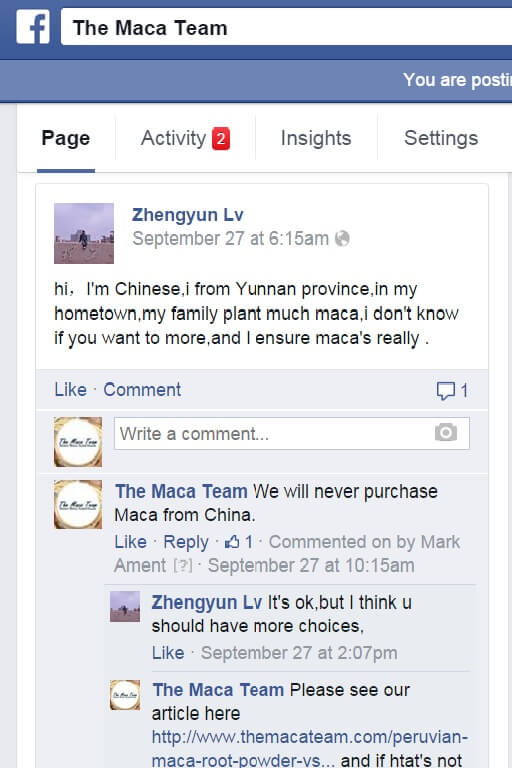
Not surprisingly, we soon began receiving offers from Chinese companies wanting to sell us Chinese-grown maca.
Just as we had suspected, part of the strategy appeared to be an attempt to establish China as a major competitor in the global maca market.
We decided that we would never purchase Chinese-grown maca, both because of our quality concerns and because of the ethical issues surrounding what had happened in Peru.
If you love maca, we continue to recommend insisting on Peruvian-grown maca. Our reasons are explained in detail on our Peruvian Maca vs. Chinese Maca page.
The following updates were published as events unfolded during the 2014–2015 crisis.
| Date | Update |
|---|---|
| August 21, 2014 | Three government ministries in Peru — Trade, Tourism, and Agriculture — announced that they would take action against the illegal export of maca. Read the Spanish-language report. |
| August 22, 2014 | We heard from a Peruvian maca supplier that the government of Peru had stopped and seized approximately 150 tons of illegally purchased whole maca roots near the border with Ecuador. At the time, we had not independently confirmed the report. |
| August 23, 2014 | According to reports we received, the Chinese government had agreed to monitor its borders for contraband maca roots. |
| September 8, 2014 | One of our maca suppliers told us that Peruvian tax authorities were in the growing regions attempting to track down illegal transactions, although the activity had apparently not yet had much effect on the broader situation. |
| September 13, 2014 | One of the producers we worked with told us that little had improved and that the current Peruvian maca harvest could be completely depleted by the end of the year. |
| September 30, 2014 | We began receiving direct offers from China for Chinese-grown maca. We reiterated that we would not buy or sell it. Read why we continue to choose Peruvian maca. |
| October 2, 2014 | Multiple suppliers told us that the 2014 Peruvian maca harvest was almost completely gone. The roots were already out of the ground and very little inventory remained available for purchase. |
| October 6, 2014 | Reports emerged that some Chinese nationals who had entered Peru as tourists while purchasing maca had been expelled from the country. Read the report. |
| November 10, 2014 | We were reaching the bottom of the available 2014 maca harvest. What remained was being offered at extraordinarily high prices. We were quoted prices as high as $80 per kilogram and nothing below approximately $65 per kilogram for organic maca that month. We continued building inventory to avoid gaps in supply. |
| December 10, 2014 | We had secured enough high-quality maca to serve most of our customers through approximately May or June 2015. Prices were still increasing, in some cases approaching $100 per kilogram. International press attention also continued to increase. |
| December 12, 2014 | We launched our Save Peruvian Maca Petition in Spanish and English with the intention of submitting it to Peru’s Minister of Agriculture. Visit the Save Peruvian Maca page. |
| April 1, 2015 | Our suppliers in Peru told us that Chinese companies were still purchasing as much maca as they could. Farmers had planted roughly three times as much land in maca for the 2015 harvest, giving us hope that supply would improve by August. The overall situation remained volatile. |
Thank you for reading and for sharing this history with anyone who cares about high-quality heritage foods.
The 2014 maca crisis was an extraordinary period for farmers, exporters, producers, customers, and everyone involved in the Peruvian maca trade.
It also reinforced something we continue to believe strongly today: the origin of maca matters, the people who grow it matter, and protecting the traditions and agricultural communities behind this remarkable food matters.
Explore organic maca sourced from traditional growing regions in the high Peruvian Andes and produced according to the standards we have developed over decades of working with this remarkable food.