

Maca Root: How (and Why) To Get Started
If you’ve been exploring new ways to support your wellness routine, chances are you’ve come across maca root. This ancient Peruvian plant has gained popularity

Current evidence does not identify maca as a common cause of liver injury, but one published case report has linked a maca medicinal liquor to probable liver injury. Here is what the human, animal, and laboratory research actually tells us about maca and liver health.

We receive occasional questions from people wondering whether maca can affect the liver or whether it is safe to use when liver health is a concern.
The reassuring part is that maca has not emerged in the medical literature as a common cause of liver injury. However, the research is more nuanced than simply saying that maca can never affect the liver.
One published case report described probable liver injury following a very large serving of a maca-containing alcoholic medicinal liquor. At the same time, other research has investigated maca or isolated maca compounds in animal and laboratory models of liver injury, with generally favorable findings.
The key is understanding what these studies actually show—and what they do not.
This page is part of our broader guide to maca root side effects and safety, within our What Is Maca? resource.
Based on the available evidence, maca does not appear to be a common cause of liver injury in healthy people using ordinary food or supplement preparations.
Maca (Lepidium meyenii) has been studied for many years as both a traditional food and a dietary supplement. Liver-related research includes general safety evaluations, experimental animal studies, cell studies, and a single published human case report involving a maca medicinal liquor.
A useful place to start is the National Institutes of Health LiverTox review of maca. LiverTox reviews scientific evidence concerning substances that may cause liver injury.
Its review notes that clinical studies of maca have generally found it to be well tolerated and that there have been no convincing reports linking ordinary maca supplementation to clinically apparent liver injury. LiverTox assigns maca a likelihood score of E, meaning it is considered an unlikely cause of clinically apparent liver injury.
At the same time, one unusual case report deserves a closer look because it frequently appears when people search online for maca and liver damage.
| Research | Type | What It Found | What It Means |
|---|---|---|---|
| NIH LiverTox review | Clinical evidence review | No convincing reports linking ordinary maca use to clinically apparent liver injury; maca classified as an unlikely cause. | The strongest overall safety summary is reassuring, while acknowledging that available human data are limited. |
| 2017 medicinal-liquor case report | Single human case report | A man developed liver injury after drinking 300 mL of maca medicinal liquor containing 50% alcohol. The authors considered maca-related drug-induced liver injury probable. | An important safety signal, but one unusual case cannot establish how ordinary maca products affect the general population. |
| 2017 maca polysaccharide study | Cells and mice | Maca polysaccharides showed protective effects in experimental models of alcohol-related oxidative liver injury. | Interesting preclinical research, but it does not demonstrate a liver benefit in humans. |
| 2022 red maca study | Rat study | Red maca extract reduced several markers associated with acrylamide-induced oxidative stress and liver toxicity. | Encouraging animal research that cannot yet be generalized to human liver health. |
| 2024 maca polysaccharide study | Mice and laboratory cells | Maca polysaccharides reduced several measures of aflatoxin-related liver injury in the experimental models. | Further preclinical evidence, but not proof that maca prevents or treats liver injury in people. |
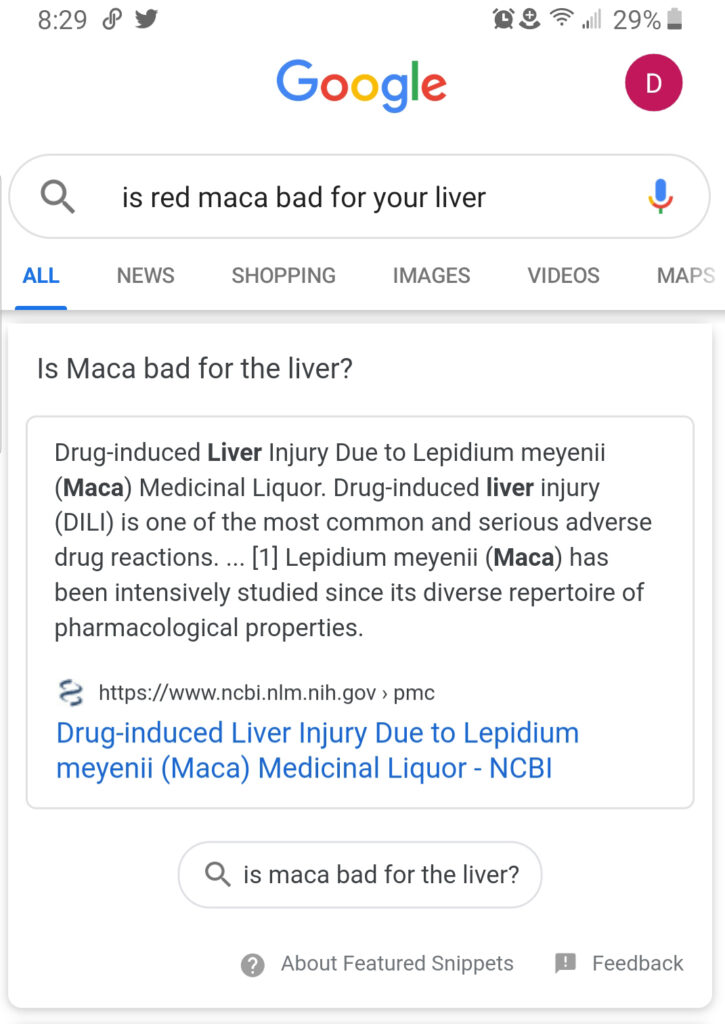
If you search for terms such as “maca liver damage,” you may encounter a medical paper titled Drug-induced Liver Injury Due to Lepidium meyenii (Maca) Medicinal Liquor.
The title understandably sounds concerning, so it is worth looking closely at what actually happened.
The report involved a 30-year-old man who consumed 300 mL—roughly 10 fluid ounces—of a maca medicinal liquor containing 50% alcohol in a single occasion. Ten days later he was admitted to a hospital with symptoms that included abdominal discomfort, sour regurgitation, burping, and jaundice.
His liver enzymes were markedly elevated. The medical team ruled out several other potential explanations, including common viral and autoimmune causes, and assessed the case as highly probable drug-induced liver injury.
The patient’s condition improved after treatment and discontinuation of the product, although normalization of some liver measurements took several months.
The case is important and should not be dismissed. At the same time, it is very different from ordinary use of maca powder, capsules, or a typical serving of an alcohol-free maca extract.
Several factors make it difficult to translate this single report into a general conclusion about maca:
The authors themselves stated that the mechanism was unclear and that additional research was needed.
So the appropriate conclusion is not that the case proves maca is dangerous to the liver—and it is also not appropriate to claim that alcohol definitely caused the reaction instead of maca.
It is best understood as one unusual but legitimate safety report that should be considered alongside the much larger body of evidence.
Several studies have produced interesting results suggesting that maca or isolated compounds from maca may influence oxidative stress and other processes involved in experimental liver injury.
For example:
These findings are scientifically interesting, but there is an important limitation: they are not clinical trials showing that maca improves liver disease in people.
Animal and cell studies help researchers understand biological mechanisms and identify questions worth studying further. They should not be used to claim that maca prevents, treats, detoxifies, or repairs the human liver.
For most healthy adults, the available evidence does not suggest that ordinary maca use is a significant liver-safety concern.
A more cautious approach makes sense if you:
In those situations, discuss maca and other supplements with a qualified healthcare professional who knows your medical history.
There is currently no good human evidence showing that red, black, yellow, or tri-color maca is safer for the liver than another color.
Likewise, there is no evidence that gelatinized maca provides a special liver benefit. Raw and gelatinized maca differ primarily in processing and digestibility, not in any established ability to support liver function.
For liver safety, more useful considerations are:
You can learn more about our approach to sourcing, testing, and product quality in Our Standards.
Current evidence does not indicate that ordinary maca use is a common cause of liver injury. The NIH LiverTox database classifies maca as an unlikely cause of clinically apparent liver injury. However, one published case report described probable liver injury after consumption of a large amount of maca medicinal liquor.
There is one published human case report linking a maca-containing medicinal liquor to probable drug-induced liver injury. That unusual case involved 300 mL of a 50% alcohol medicinal liquor consumed at one time. It does not establish that normal servings of ordinary maca powder, capsules, or extracts commonly cause liver damage.
If you have a diagnosed liver condition, it is best to discuss maca with your healthcare professional before adding it to your routine. Research on maca use specifically in people with liver disease is limited, and an individual medical history can matter more than general supplement information.
There is not good clinical evidence showing that maca “detoxifies” the human liver. Some laboratory and animal studies have examined maca in experimental models of liver injury, but these findings should not be interpreted as proof of a detoxifying effect in people.
There is currently insufficient human research to conclude that maca improves or treats fatty liver disease. Anyone managing fatty liver disease should follow guidance from a qualified healthcare professional rather than relying on maca as a treatment.
There is not enough evidence to say that maca is compatible with every medication used for liver conditions. If you take prescription medication or have impaired liver function, ask your physician or pharmacist about adding maca or any other supplement.
No maca color or preparation has been proven to be better for human liver health. Red, black, yellow, and tri-color maca have not been directly compared for this purpose. Gelatinized maca may be easier for some people to digest, but that is a digestive consideration rather than an established liver benefit.
Stop taking the product and seek appropriate medical advice if you develop concerning symptoms such as jaundice, dark urine, significant abdominal discomfort, persistent nausea, or other unusual symptoms after starting maca or another supplement.
This page is part of our Maca Root Side Effects & Safety section within the larger What Is Maca guide.
Start with our main side-effects guide for a broader look at maca safety, precautions, and common questions.