
How to Choose a High-Quality Maca Brand
How to Choose a High-Quality Maca Brand
Updated on
Reviewed by TMT editorial board
Maca is a traditional root food grown in the high Andes and commonly sold as a powder, capsule, extract, or ingredient in a blend.
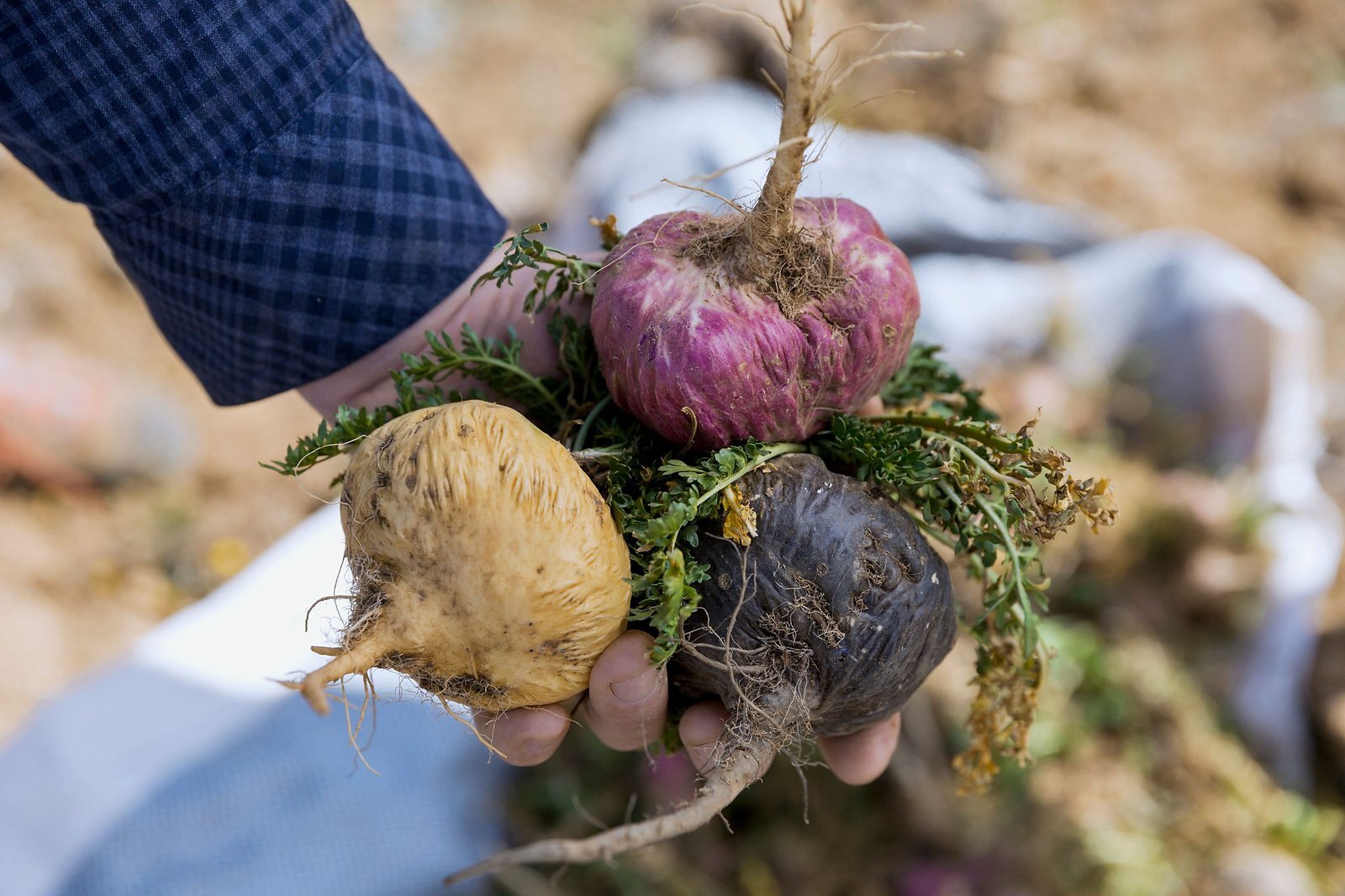
The products may look similar online, but their quality can vary.
Important differences include where the maca was grown, how it was farmed and processed, whether the finished product was tested, how long it was stored, whether the batch can be traced, and how accurately the company represents what it sells.
A good maca company should do more than sell a package. It should help customers understand what they are buying and how the available forms differ.
Quick answer:
A high-quality maca brand should clearly show where its maca is grown, how it is processed, whether it is certified organic, and how it is tested.
Look for specific Peruvian sourcing, current batch testing, accessible Certificates of Analysis, simple ingredient lists, protective packaging, realistic claims, and a company that can answer detailed questions about its products.
The best maca brand is not necessarily the one making the biggest promises. It is the one providing the clearest evidence about the origin and quality of what it sells.
A Quick Maca Brand Scorecard
Use this comparison when evaluating maca brands and products.
No single factor proves that a brand is excellent. The strongest quality picture comes from several forms of evidence working together.
Can the Brand Prove Where Its Maca Comes From?
Maca has a specific cultural and agricultural origin.
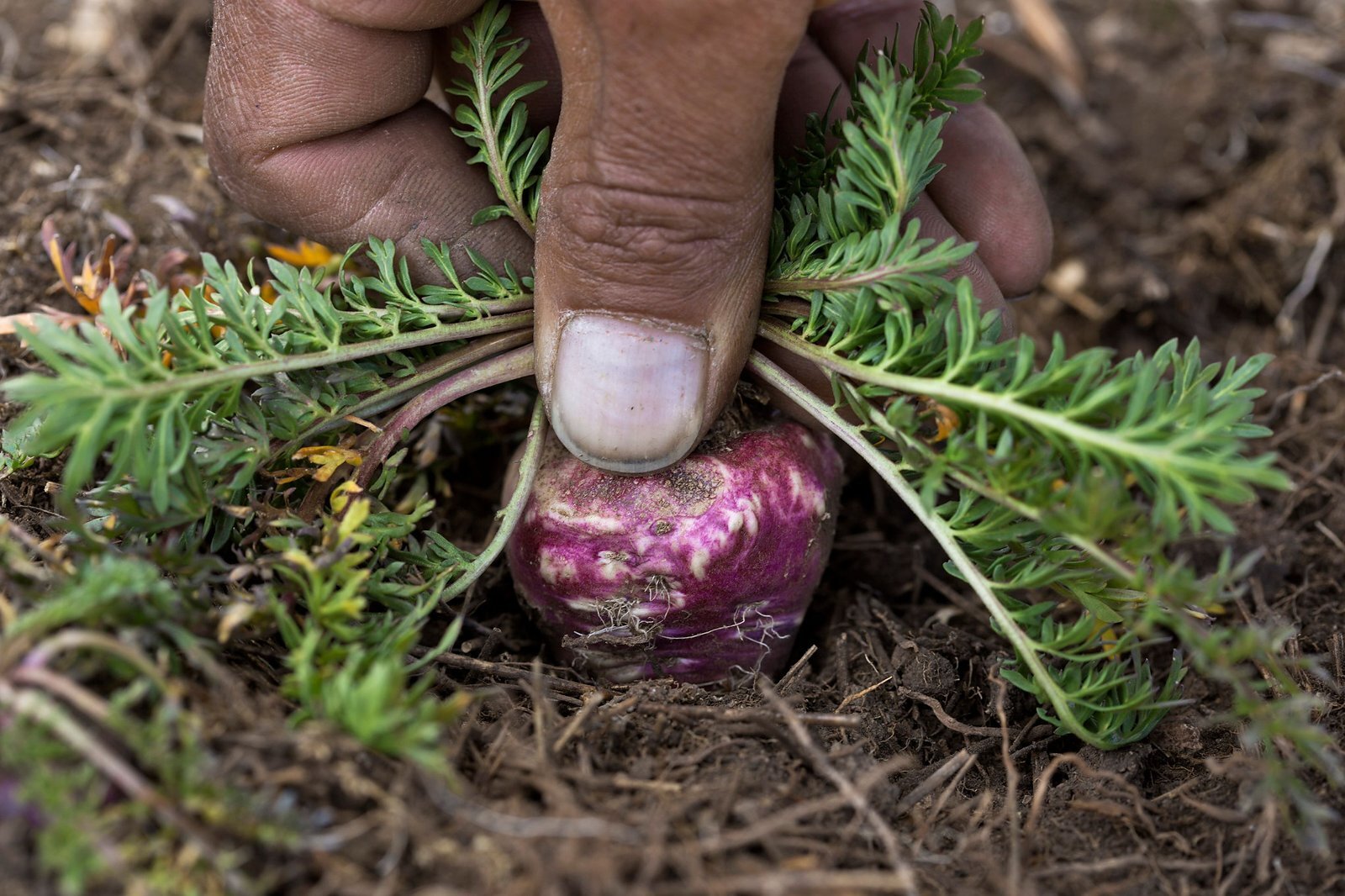
It has traditionally been cultivated in the high-elevation regions of central Peru, particularly in areas such as Junín and Pasco. These regions have a long history of maca farming under demanding mountain conditions.
A reliable brand should be able to explain:
- The country and region where its maca was grown
- Who grows or supplies it
- Whether the product contains only Peruvian maca
- How the batch is traced through processing
- Whether the company has an established sourcing relationship
Statements such as “sourced from the Andes” or “imported from South America” are less useful than specific regional and supply-chain information.
Good sourcing does not require romantic language. It requires specifics.
Learn more about how responsible maca sourcing works.
Peruvian Origin Is Important, but It Is Not Enough
Choosing Peruvian maca is a sensible starting point, but origin alone does not guarantee quality.
Authentic Peruvian maca can still be poorly dried, exposed to moisture, stored too long, blended with other material, or sold without appropriate contaminant testing.
The better question is:
Can the brand show a complete quality chain from farm to finished product?
That chain should include responsible sourcing, appropriate processing, traceability, testing, packaging, and storage.
Look for Certified Organic Maca
Terms such as “natural,” “pure,” “premium,” and “clean” may sound reassuring, but they do not mean the same thing as certified organic.
Organic certification helps verify that the crop was grown and handled according to an established organic standard. It also provides oversight of the organic supply chain and the use of the word “organic.”
For maca, certification is a useful baseline because maca is a root crop grown in direct contact with the soil.
Look for:
- A recognized organic seal
- The name of the certifying organization
- Organic information on the label or product page
- Consistent claims across the company’s packaging and website
Organic certification does not prove everything about a product. It does not automatically establish freshness, proper storage, identity, or contaminant levels. That is why certification should be supported by testing and traceability.
Check the Brand’s Testing and COAs
A Certificate of Analysis, or COA, reports laboratory results for a product, ingredient, or production lot.
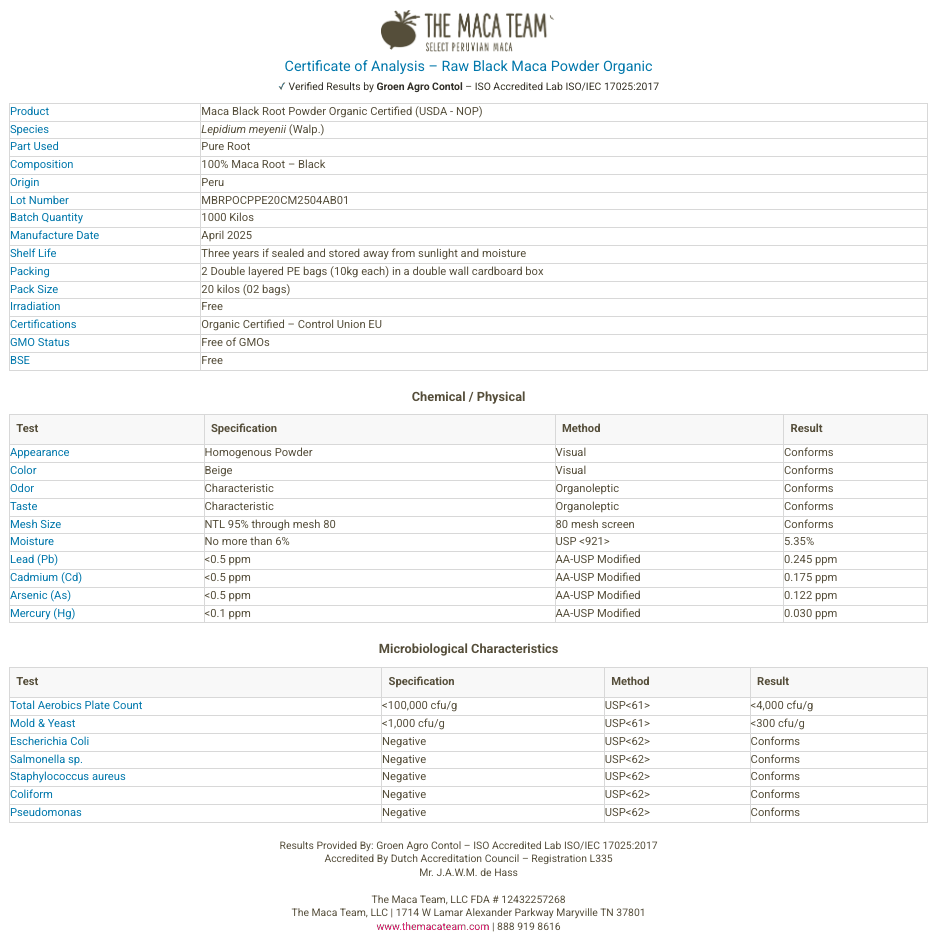
For maca, a testing program may address:
- Product identity
- Heavy metals
- Microbial safety
- Pesticides
- Moisture
- Other company quality specifications
The words “lab tested” are not enough by themselves. Look for meaningful results that are current and connected to the batch being sold.
What a Useful COA Should Show
Not every analysis must appear on a single document. Some companies use separate reports for identity, pesticides, heavy metals, and microbiological testing.
The key question is whether the overall testing program is appropriate and traceable to the finished product.
How to Review a COA Quickly
You do not need technical expertise to conduct a basic review.
- Does the product name match what is being sold?
- Is there a batch or lot number?
- Is the testing reasonably current?
- Is the laboratory identified?
- Does the report show what was tested?
- Are the results accompanied by specifications, limits, or a pass/fail determination?
A generic sample report is better than no information, but it does not provide the same assurance as current, lot-specific testing.
You can also review our full explanation of maca quality specifications.
Why Heavy-Metal and Microbial Testing Matter
Root crops naturally grow in contact with soil. This does not make them unsafe, but it does make testing important.
Metals such as lead, cadmium, arsenic, and mercury can occur in agricultural environments. A quality-focused brand should establish limits for these contaminants and reject material that does not meet its standards.
Dried plant products should also be evaluated for microbial safety. Depending on the product, this may include yeast, mold, total microbial counts, and specific pathogens.
Testing, responsible sourcing, organic certification, proper packaging, and active inventory management all involve real costs.
The most expensive maca is not automatically the best. However, an unusually cheap product deserves closer examination when the seller provides little sourcing or testing information.
Choose a Brand That Understands Maca Forms
A knowledgeable maca company should clearly explain its products without presenting one form as best for everyone.
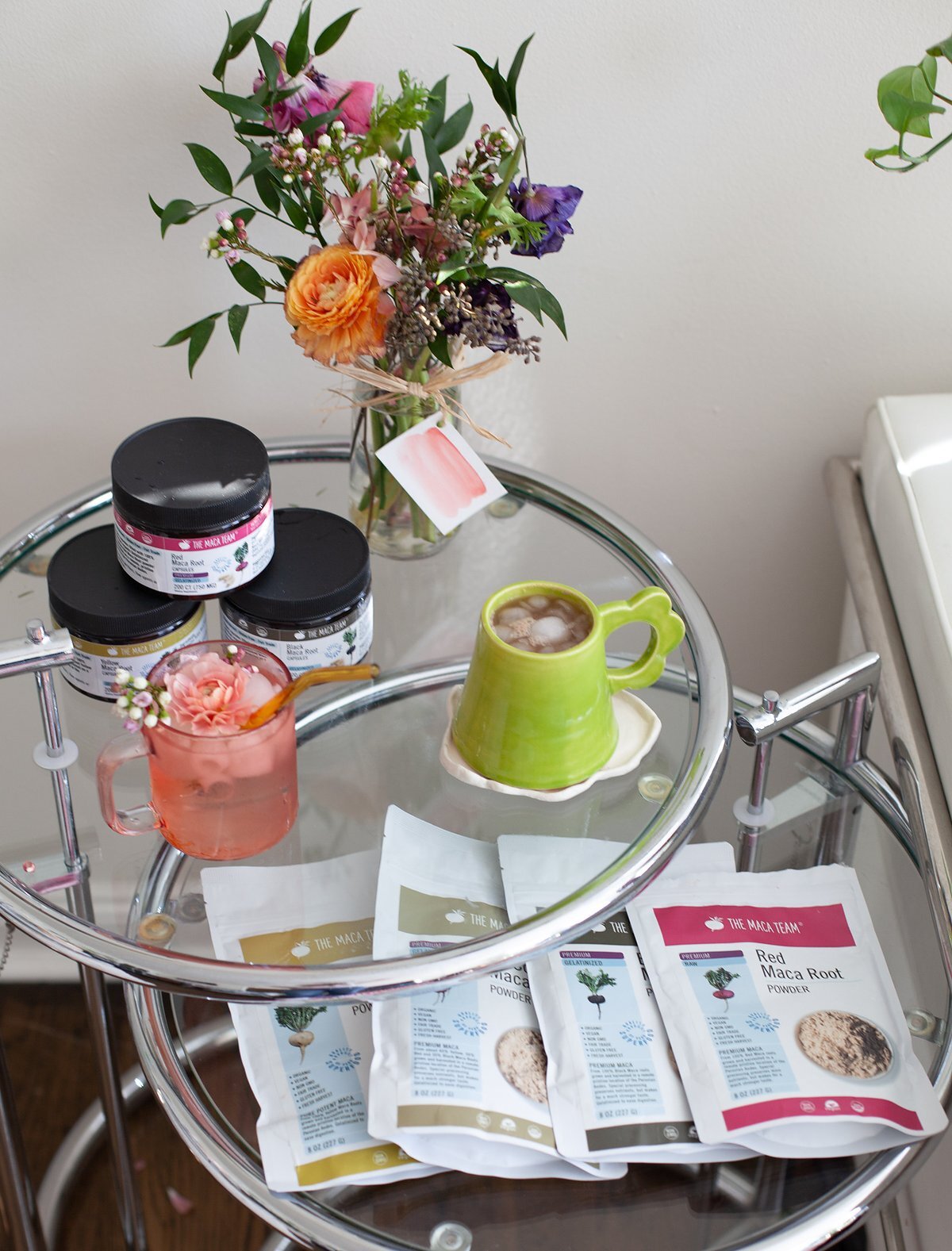
Raw Maca Powder
Raw maca powder is made from dried maca roots that are milled without undergoing gelatinization.
It retains the root’s original starch content and is commonly added to smoothies, oatmeal, yogurt, drinks, and recipes.
Some people report that raw maca is harder for them to digest, particularly when they begin with a large serving.
Gelatinized Maca Powder
Gelatinized maca does not contain gelatin. It remains plant-based.
The term refers to a heat-and-pressure process that breaks down and removes part of the starch. Many people choose it because they find it easier to digest.
Raw and gelatinized maca are different preparations. One is not automatically higher quality than the other.
Read our detailed comparison of raw versus gelatinized maca.
Maca Capsules
Maca capsules provide a convenient, measured form for people who dislike maca’s taste or do not want to measure powder.
Check:
- The type of maca used
- The amount per capsule
- The total amount per serving
- The capsule material
- Any fillers or additional ingredients
A large number of capsules in a bottle does not necessarily mean that each serving contains a meaningful amount of maca.
Maca Extracts
Maca extracts are more concentrated and can vary considerably among brands.
A responsible seller should explain:
- Whether the extract is liquid or powdered
- The extraction method
- The extract ratio or concentration
- The carrier or other ingredients
- Whether a liquid extract contains alcohol
- The recommended serving size
Terms such as “high potency” are not very informative unless the company explains what they mean.
Check the Ingredients and Serving Size
A simple product is generally easier to evaluate.
A pure maca powder should contain maca.
A maca capsule should usually contain maca, the capsule material, and any clearly disclosed manufacturing ingredients.
An extract should explain its maca source, extraction base, concentration, carrier ingredients, and serving size.
Blended products can also be legitimate, but the amount of maca should be clear.
Watch for proprietary blends:
A label might list a 1,000-milligram “energy blend” containing maca, caffeine, mushrooms, herbs, and other ingredients without stating how much maca is actually present.
Without that information, it is difficult to compare the product with pure maca.
Look for Honest, Useful Guidance
A reputable company should help customers choose a suitable form rather than automatically recommending its most expensive product.
Useful guidance may address:
- Whether raw or gelatinized maca is a better starting point
- How powders, capsules, and extracts differ
- How much to begin with
- When to increase the serving
- Whether to take maca with food
- What to do if digestive discomfort occurs
- How yellow, red, black, and tri-color maca compare
- When to stop using a product or speak with a healthcare professional
A maca-focused company may be better equipped to answer these questions than a general supplement seller carrying hundreds of unrelated products.
Specialization does not prove quality by itself, but it is valuable when combined with sourcing knowledge, testing, and transparency.
Be Cautious of Exaggerated Claims
The way a company talks about maca can reveal a great deal about its standards.
Maca should not be marketed as a cure, a guaranteed treatment, or a replacement for professional medical care.
Be cautious with claims such as:
- “Balances hormones instantly”
- “Treats infertility”
- “Guaranteed testosterone booster”
- “Works for everyone”
- “Stronger than medication”
A responsible brand will distinguish among traditional use, customer experiences, emerging research, and established evidence.
It will also acknowledge that people may respond differently.
In many cases, restraint is a sign of credibility.
Learn more about The Maca Team’s standards for responsible maca information.
Freshness, Packaging, and Storage Matter
Maca is dried and shelf-stable, but it should not sit indefinitely in poorly controlled warehouses or marketplace inventory.
Like other dried botanical foods, it should be protected from moisture, excessive heat, air, and direct light.
Look for:
- A lot number
- A best-by date
- Food-appropriate packaging
- A reliable resealable closure
- Clear storage instructions
- An identifiable company and seller
The label should also show the product name, net weight, serving size, ingredients, company information, and any required nutritional or supplement information.
Marketplace listings can be convenient, but verify who is selling the product. Storage conditions, inventory age, and access to testing information may vary between the brand itself and an unrelated third-party seller.
Customer Service Is a Quality Signal
A company should be able to answer basic questions about its maca.
Consider asking:
- Where was this maca grown?
- Is it raw or gelatinized?
- Is it certified organic?
- Can I review the current test results?
- Is the product 100% maca?
- What is the amount of maca per serving?
- Which form is most suitable for beginners?
- Which option may be easier to digest?
The answers should be clear and consistent with the product label and website.
Be cautious when you cannot identify the company behind a product, find meaningful contact information, or determine who is responsible for its quality.
The issue is not company size. A small brand can be highly transparent and accountable.
How The Maca Team Approaches Maca Quality
At The Maca Team, we believe maca quality begins long before a finished product reaches a bag, jar, or bottle.
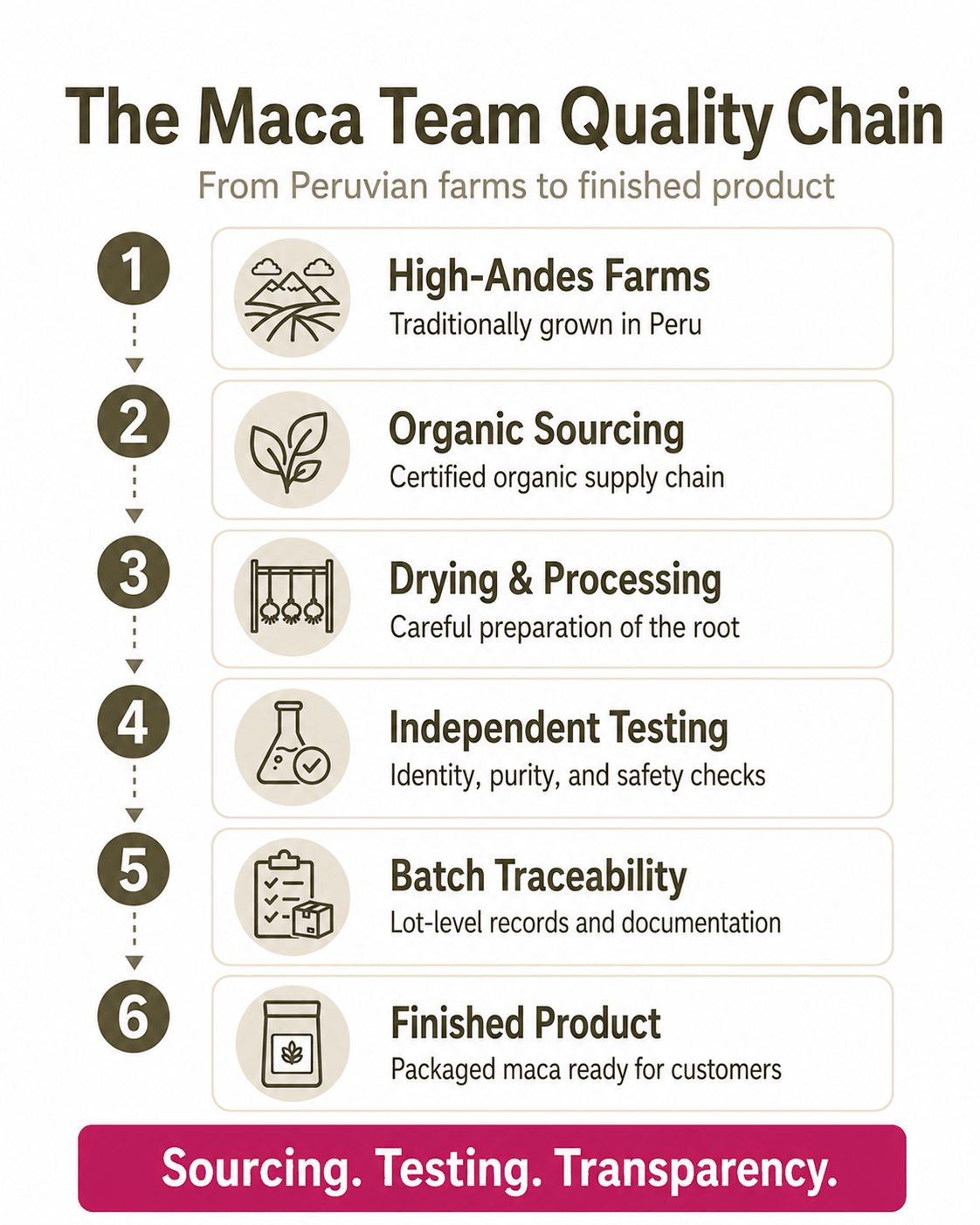
Our approach includes:
- Sourcing Peruvian maca from traditional high-Andes growing regions
- Working with established farming communities and production partners
- Offering certified organic, additive-free maca products
- Maintaining traceability throughout sourcing and production
- Testing every batch through independent laboratories
- Making COAs and testing information available
- Explaining the differences among forms, colors, and preparation methods
- Avoiding exaggerated promises
Customers should be able to understand where a product comes from, what it contains, how it was processed, and how its quality was evaluated.
That is why sourcing, testing, education, and transparency remain central to how we work.
Review The Maca Team’s complete sourcing, testing, and transparency standards.
Final Maca Brand Buying Checklist
Before choosing a maca brand, confirm that you can answer these questions:
- Where was the maca grown?
- Is it certified organic?
- Can the batch be traced?
- Are current test results available?
- Is the ingredient list clear?
- Does the company explain the product form?
- Are the claims realistic?
- Is the product properly packaged?
- Is there a lot number and best-by date?
- Can the company answer detailed questions?
If most of these answers are clear, the brand is giving you meaningful evidence to evaluate.
Choose proof over promises.
Frequently Asked Questions About Maca Brand Quality
What is the most important sign of a high-quality maca brand?
Transparency is one of the strongest signs. A good brand should explain where its maca comes from, whether it is certified organic, how it is processed, and how it is tested.
Is Peruvian maca better than maca from other countries?
Peru is maca’s traditional home and has the strongest historical and agricultural connection to the crop. For customers seeking authentic maca, 100% Peruvian maca is generally the best starting point.
Origin should still be considered alongside processing, testing, freshness, and traceability.
Is organic maca worth buying?
Certified organic maca is a sensible choice because certification provides oversight of farming and handling practices.
Organic status should still be supported by testing and transparent sourcing.
Is raw or gelatinized maca higher quality?
Neither is automatically higher quality.
Raw maca retains its original starch content. Gelatinized maca is processed to remove part of the starch and may be easier for some people to digest.
Should maca have a COA?
A brand should ideally make current, relevant testing information available.
Lot-specific results provide more useful assurance than a generic sample document.
Are maca capsules as good as powder?
They can be, provided the capsules contain high-quality maca and clearly disclose the amount per serving.
Capsules offer convenience, while powder is more flexible for drinks, smoothies, and recipes.
Are maca extracts better than whole-root maca?
Not necessarily. Extracts are more concentrated, but they are different products rather than automatically superior ones.
A quality extract should disclose its ingredients, extraction method, concentration, and serving size.
What should I avoid in a maca brand?
Be cautious of vague sourcing, inaccessible test results, hidden proprietary blends, exaggerated medical claims, unclear serving sizes, poor traceability, and products with no accountable company behind them.
Which maca product is best for beginners?
Many beginners choose a simple tri-color powder or capsule product. People with sensitive digestion may prefer gelatinized maca.
A knowledgeable brand should help customers compare the available options clearly.
Helpful Next Steps
- Explore our maca buying guides
- Review our sourcing, testing, and transparency standards
- Learn how our maca is sourced
- Learn how to read maca testing and COAs
- Review our maca quality specifications
- Compare raw and gelatinized maca
- Find the maca form and color that may fit you best
- Shop organic Peruvian maca products