
Which Brands Offer High-Quality Maca Root Capsules
Reviewed by: The Maca Team Editorial Board
We compare high-quality maca root capsules from The Maca Team, Gaia Herbs and NOW Foods, including ingredients, sourcing, processing, testing, selection and price.
We’ve been sourcing and selling high-quality Peruvian-grown maca powder for almost two decades. And for the past fifteen years, we’ve been selling that same maca powder in capsule form.
Early on, we made some specific decisions about how we wanted our capsules made. These included:
- Only using vegan capsules
- Filling capsules with only pure maca powder, with no fillers, flow agents or other ingredients
- Maintaining complete transparency in terms of origin and processing
Before we launched our capsule range, we learned that large packing facilities don’t always prioritize capsule quality. They may use fillers or flow agents to help their machines run efficiently, and we weren’t confident that our maca powders would always be handled with the level of care we wanted.
For that reason, we invested in our own capsule-making equipment and, from the very beginning, have filled our capsules in-house.
As a small company dedicated exclusively to maca, we’re proud to be able to maintain that level of integrity and quality. And when customers reach out to ask how our maca capsules compare with other reputable brands, we’re happy to answer.
In this article, we’ll take a deeper look at capsules from three reputable brands — The Maca Team, Gaia Herbs and NOW Foods — and compare everything from ingredients, capsule type and processing to product selection, transparency and price.
Hopefully, this will be helpful as you decide which brand best fits your needs.
Note: There are many other maca capsules available from other brands, with significant variation in product origin, quality, ingredients, price and processing. We intentionally limited this comparison to brands with a clear focus on quality, sourcing and transparency.
Questions to Ask Before Purchasing Maca Capsules
Over the years, we’ve learned that maca capsules that look very similar from the front of the bottle can actually be quite different.
Before choosing one, these are some of the things we think are worth checking:
- Where was the maca grown?
- Is it certified organic?
- How much maca is actually in each capsule?
- Are fillers, lubricants or processing aids added?
- Is the maca whole-root, raw, gelatinized or concentrated in any way?
- What color maca roots were used in the capsules?
- Are testing results and batch traceability available to consumers?
- What is the price relative to the actual quantity of maca in the bottle?
How Do Maca Capsules from The Maca Team, Gaia Herbs and NOW Foods Compare?
Here is how several current capsule options from these three brands compare.
| Brand / Product | Maca Type | Organic? | Maca / Cap. | Count | Price* | Maca / Bottle | Approx. Cost / g |
|---|---|---|---|---|---|---|---|
| The Maca Team – Raw Tri-Color | Whole-root raw | Yes | 750 mg | 200 | $19.53 | 150 g | $0.13 |
| The Maca Team – Gelatinized Tri-Color | Gelatinized | Yes | 750 mg | 200 | $20.03 | 150 g | $0.13 |
| Gaia Herbs – Maca Root | Whole-root gelatinized | Yes | 500 mg | 60 | $21.59 | 30 g | $0.72 |
| NOW Foods – Maca 500 mg | Whole-root | No organic claim | 500 mg | 100 | $13.99 | 50 g | $0.28 |
| NOW Foods – Maca 500 mg | Whole-root | No organic claim | 500 mg | 250 | $29.99 | 125 g | $0.24 |
| NOW Foods – Maca 750 mg Raw | 6:1 concentrate; label also says gelatinized | Yes | 750 mg | 90 | $26.99 | 67.5 g† | $0.40† |
*Prices checked September 2026 and are subject to change. Manufacturer-direct prices are used for The Maca Team and NOW Foods. Gaia pricing reflects the cited retailer price. Prices exclude shipping, tax, subscription discounts and temporary promotions.
†NOW’s 750 mg product is a 6:1 concentrated ingredient and is not directly comparable gram-for-gram with standard whole-root maca powder. Its label states that 750 mg is equivalent to 4,500 mg of fresh maca root. Cost per gram throughout this article refers to the listed finished maca ingredient, not equal potency or equivalent processing.
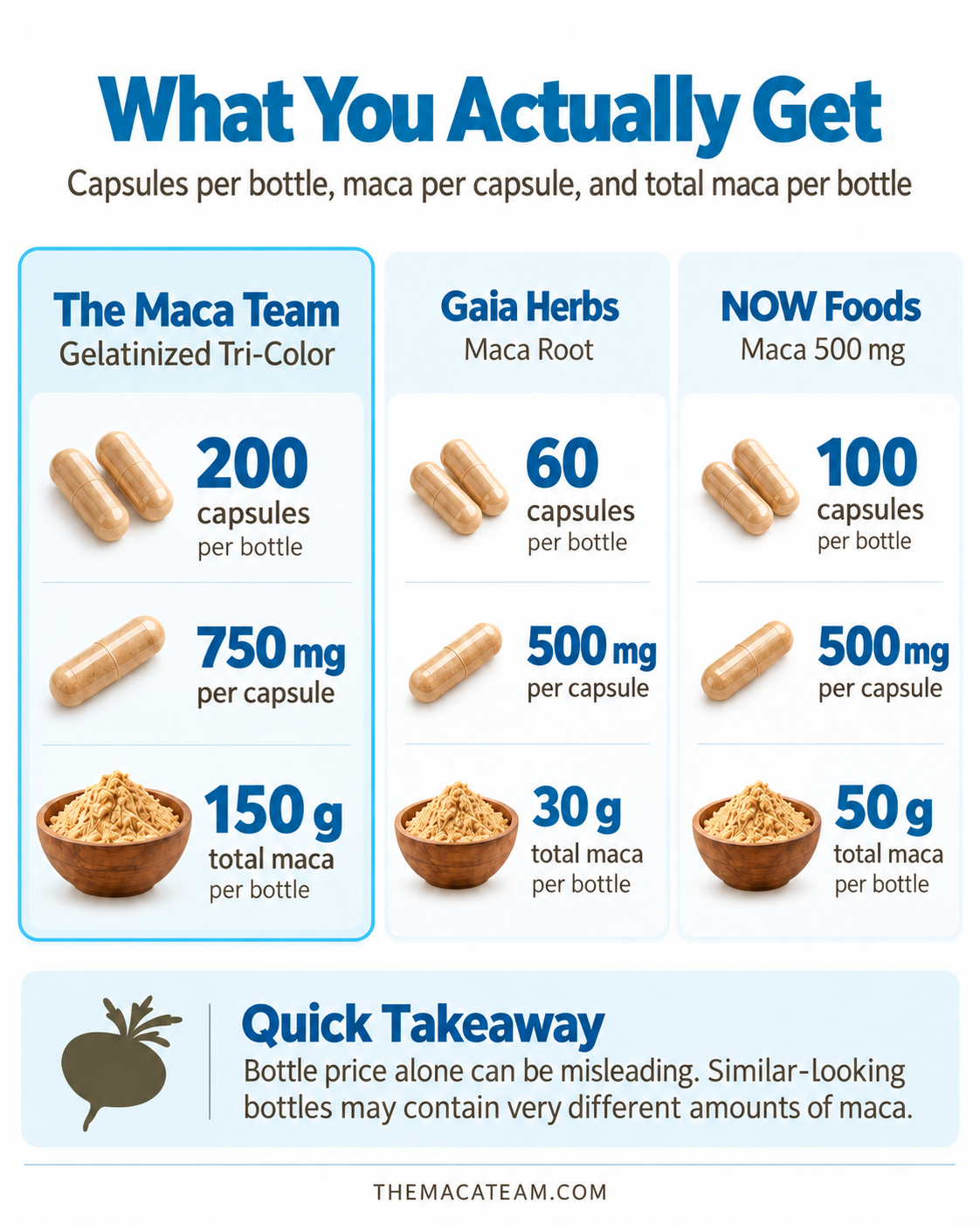
Looking only at bottle price can therefore be misleading.
Gaia and The Maca Team, for example, have similarly priced bottles, but Gaia’s 60-count bottle contains 500 mg per capsule, or approximately 30 grams of maca total. A standard 200-count Maca Team bottle contains 750 mg per capsule, or approximately 150 grams of maca total — five times the amount of maca by weight in the Gaia bottle.
NOW’s standard 500 mg product falls between the two on a price-per-gram basis. Its larger 250-count bottle contains approximately 125 grams of maca.
NOW also offers a second 750 mg organic maca product, but that product is a 6:1 concentrate and should therefore be evaluated separately rather than treated as a direct 750 mg-to-750 mg comparison with whole-root maca powder.
The Maca Team
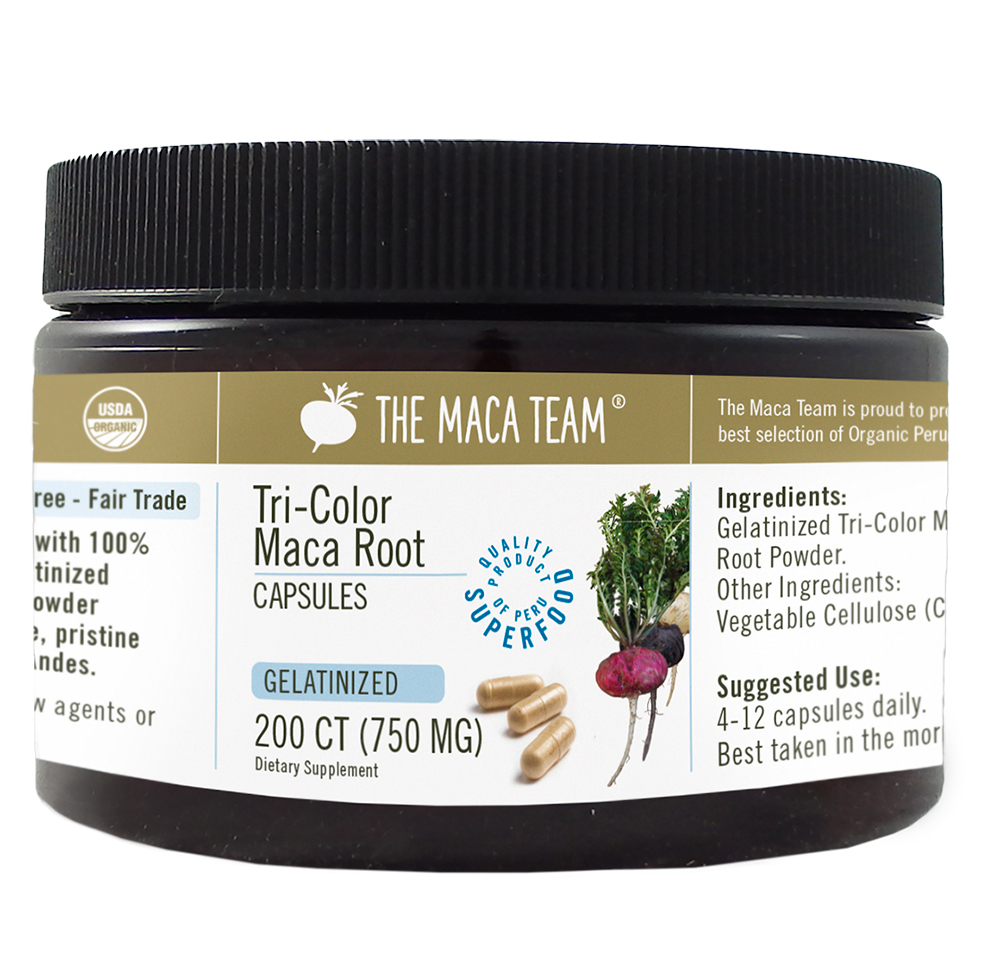
We specialize exclusively in Peruvian maca rather than offering maca as one supplement among hundreds.
Our standard capsules contain 750 mg of maca root powder, and our standard bottles contain 200 capsules.
Ingredients
Maca root powder — approximately 99%
Vegetable cellulose capsule — approximately 1%
We don’t add fillers, flow agents, binders, preservatives, stearates or other ingredients to the maca. And, as mentioned above, we fill our capsules in-house rather than outsourcing them to a large contract encapsulation facility.
Our maca is certified organic, non-GMO, vegan and grown in the high Andes of Peru. We source from traditional farming cooperatives in the Junín and Pasco regions and maintain lot-level traceability.
Selection
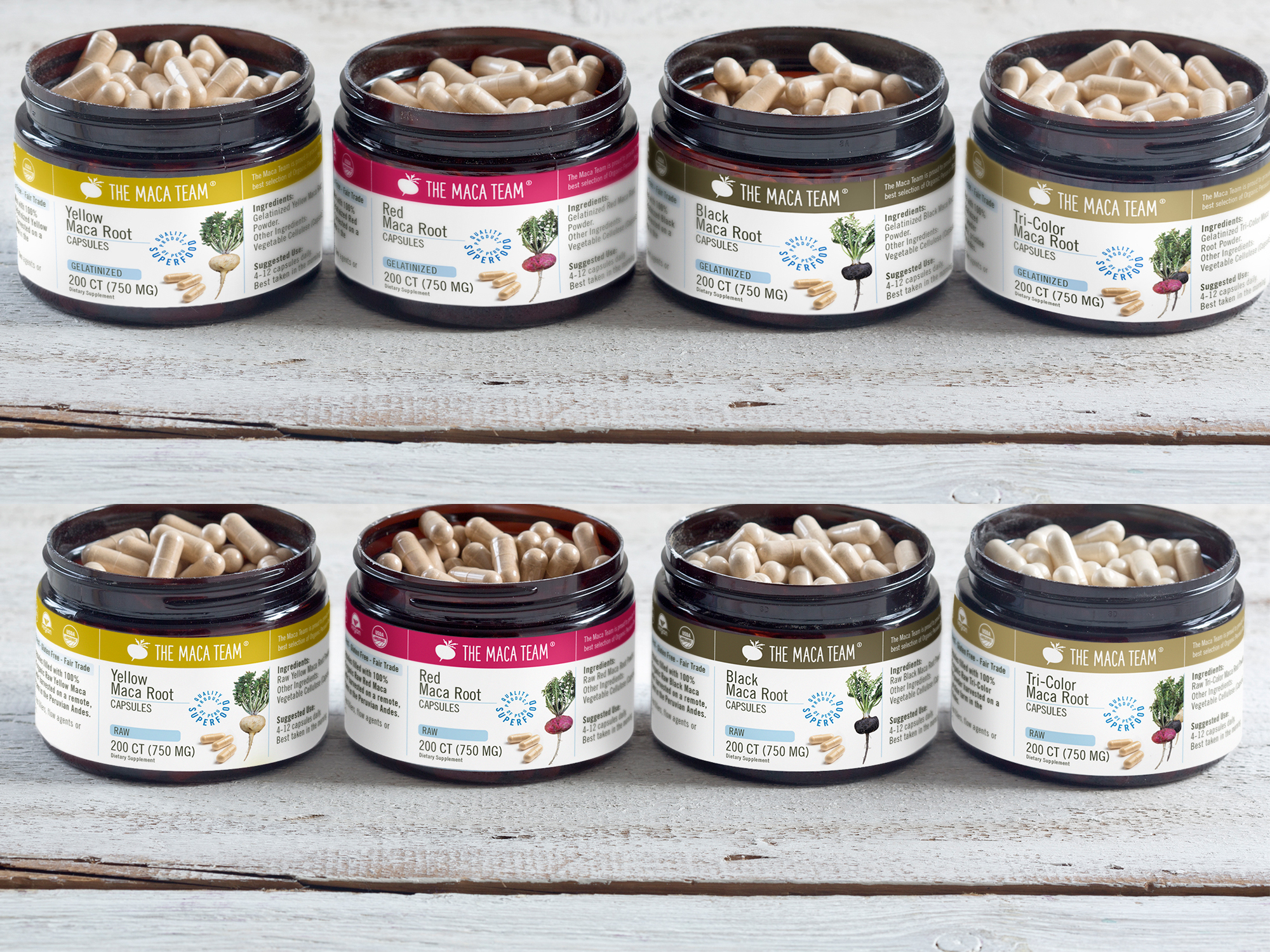
We currently offer 14 maca capsule varieties across yellow, red, black and traditional tri-color maca, with raw, gelatinized, premium raw and premium gelatinized options depending on the color.
If you’re specifically looking for a certain maca color or processing method, you don’t have to settle for a single generic maca capsule. Our guides to black, red and yellow maca and raw vs. gelatinized maca explain these differences in more detail.
Current 200-count capsule prices range from approximately $19.53 to $26.13. Examples include Raw Tri-Color at $19.53, Gelatinized Tri-Color at $20.03, Raw Red at $21.98, Gelatinized Red at $22.71, Raw Black at $23.98 and Gelatinized Black at $23.96. Premium preparations are generally about $24–$26.
Because our standard bottles contain 200 capsules at 750 mg each, they contain approximately 150 grams of maca. Standard products currently work out to roughly 13–16 cents per gram, while premium preparations remain around 16–17 cents per gram.
Testing and Traceability
Every batch of our maca is tested by independent laboratories accredited to ISO/IEC 17025:2017. Testing includes identity, heavy metals, microbiology, pesticides and residues, moisture and other quality measures.
Current batch Certificates of Analysis are published directly on individual product pages, and exact-batch COAs can be provided when an older lot is no longer displayed online. You can learn more on our Our Standards page.
Gaia Herbs Maca Root
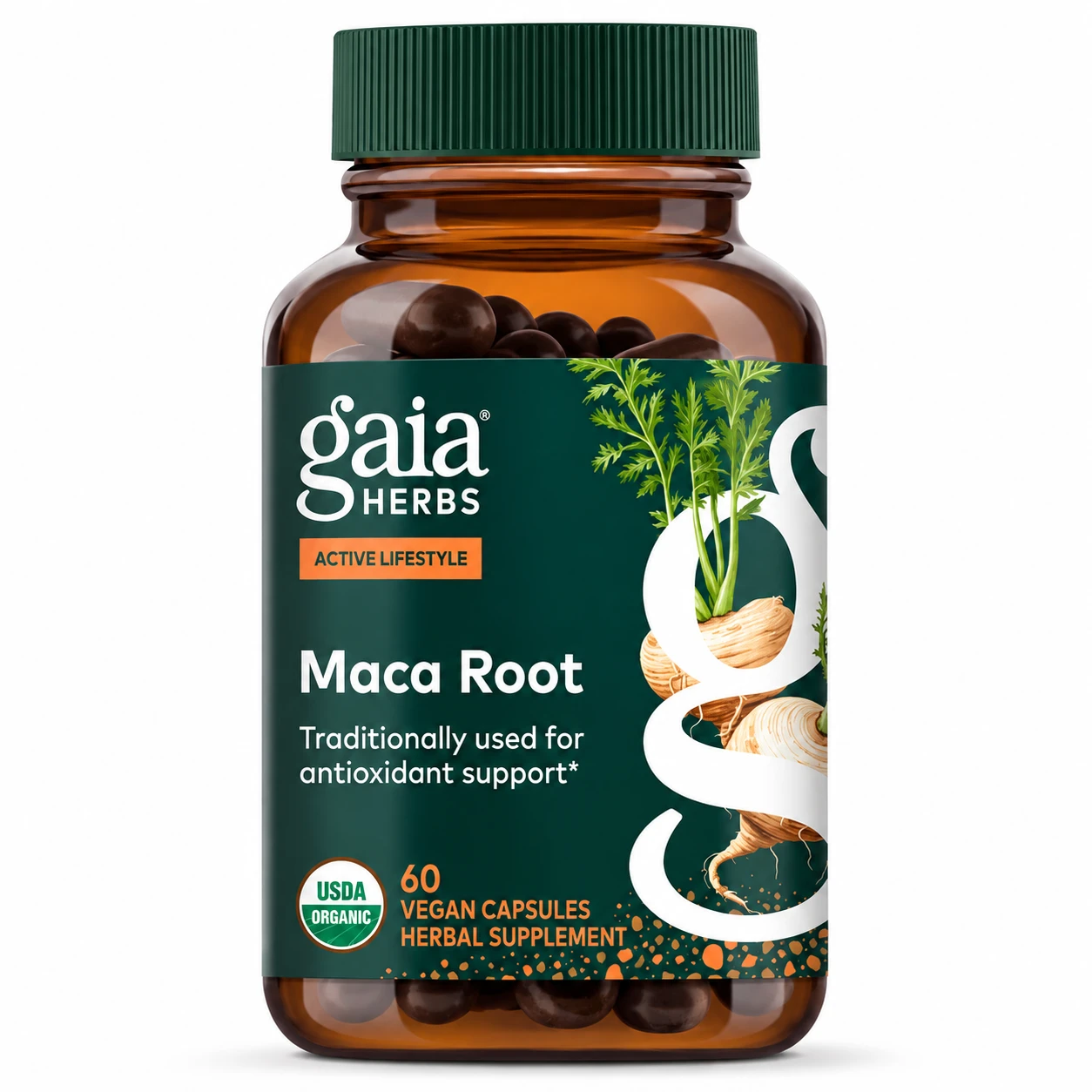
Gaia Herbs is a well-established herbal supplement company with strong sourcing and testing standards. Its primary standalone maca capsule is Organic Gelatinized Maca Root.
Each capsule provides 500 mg of maca, and a bottle contains 60 capsules.
Ingredients
Organic gelatinized maca (Lepidium meyenii) root
Organic vegan capsule (organic pullulan)
There are no conventional fillers or flow agents in the product. Pullulan is a plant-based polysaccharide made through fermentation and is used to make the capsule shell. Gaia identifies its pullulan capsule as organic.
Gaia states that it uses whole gelatinized maca root rather than an extract. The maca is organically grown, sourced from trusted partners in the Peruvian Andes, traditionally sun-dried and gelatinized for easier digestion.
A 60-count bottle is currently listed at approximately $21.59 through the cited retailer. At 500 mg per capsule, that represents approximately 30 grams of maca per bottle, or about $0.72 per gram of maca.
Selection
Gaia currently offers one standalone pure maca capsule formula — organic gelatinized whole-root maca — as well as organic gelatinized maca powder and some multi-herb formulas containing maca.
It does not currently offer separate red, black, yellow or tri-color pure maca capsules, nor a choice between raw and gelatinized maca capsules. For someone specifically looking for a simple organic gelatinized whole-root maca capsule, however, Gaia offers a very clean formulation.
Testing and Traceability
Gaia states that each product is tested for microbes and heavy metals in its on-site ISO-certified laboratory. Its Meet Your Herbs program also allows customers to use the Herb ID on a package to view origin, manufacturing information and details about quality testing for that product batch.
NOW Foods Maca Root
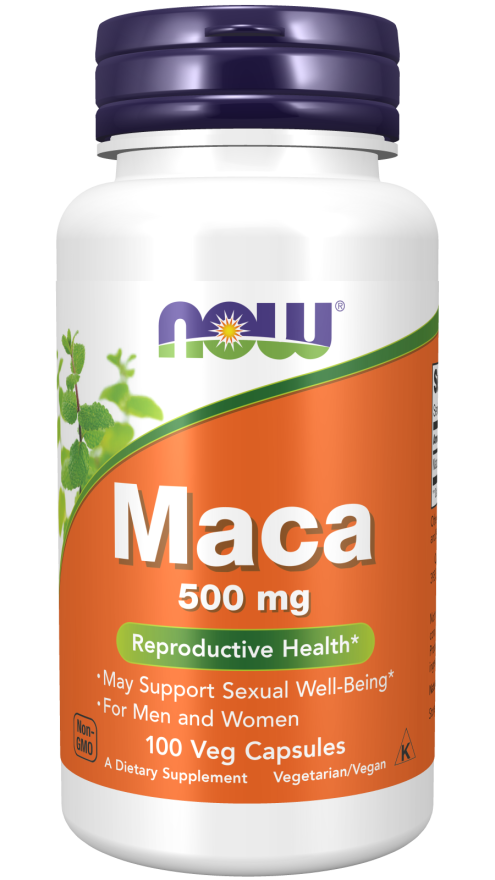
NOW Foods is one of the largest and longest-established supplement manufacturers in the United States.
It currently offers two standalone maca capsule formulations: a basic 500 mg maca root capsule and a 750 mg organic 6:1 maca concentrate.
NOW Maca 500 mg
The standard NOW product provides 500 mg of maca root per capsule and is available in 100- and 250-capsule bottles. NOW states that the maca is grown at high elevations in the Andes region of central Peru.
Other Ingredients
Hypromellose (cellulose capsule)
Stearic acid (vegetable source)
The hypromellose forms the vegetarian capsule shell. Stearic acid is commonly used in supplement manufacturing as a lubricant or processing aid.
This doesn’t make the product inherently poor quality, but it is a meaningful formulation difference for someone specifically looking for capsules without added lubricants or processing aids.
NOW labels the product non-GMO, vegan/vegetarian, kosher and halal. The current 500 mg product is not labeled as certified organic on NOW’s product page.
NOW currently lists 100 capsules at $13.99 and 250 capsules at $29.99. That works out to approximately $0.28 per gram for the 100-count bottle and $0.24 per gram for the 250-count bottle.
NOW Maca 750 mg Raw
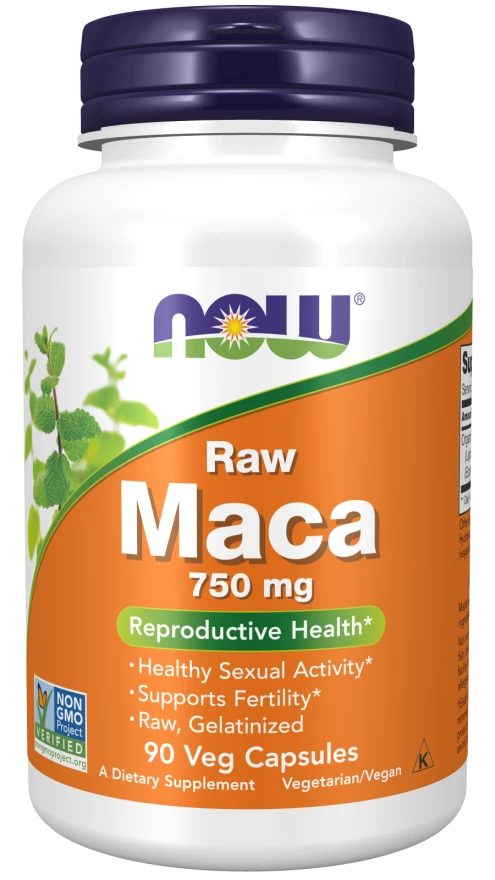
NOW also offers Maca 750 mg Raw Veg Capsules in a 90-count bottle for $26.99. This is materially different from the company’s basic 500 mg whole-root product.
The Supplement Facts panel describes the ingredient as “Organic Raw Maca Root (6:1 Concentrate)” and also identifies it as gelatinized.
NOW states that each 750 mg capsule is equivalent to 4,500 mg of fresh maca root. Because this is a concentrated, gelatinized ingredient, its 750 mg serving should not be treated as directly equivalent to 750 mg of ordinary whole-root maca powder.
Other Ingredients
Hypromellose (cellulose capsule)
Hydroxypropyl cellulose
Silicon dioxide
Stearic acid (vegetable source)
The labeling here can be a little confusing. The product name uses the word “Raw,” while the Supplement Facts panel also describes the 6:1 concentrate as gelatinized.
If processing method matters to you, it’s worth reading the full Supplement Facts and product description rather than relying on the word “Raw” in the product name.
Selection
NOW has two standalone maca capsule formulations: the 500 mg whole-root maca in two bottle sizes and the 750 mg organic 6:1 concentrate in a 90-count bottle. Neither is currently identified as a specific red, black, yellow or tri-color formulation.
Testing and Traceability
NOW maintains a large in-house quality-control program and states that its laboratories are ISO/IEC 17025 accredited. The company also provides a public Certificate of Analysis lookup by lot number, although availability of online COA data can vary by product and lot.
How Do the Ingredients and Quality Controls Compare?
| Product | Maca / Processing | Capsule & Other Ingredients | Origin / Sourcing | Testing / Traceability |
|---|---|---|---|---|
| The Maca Team |
Certified organic Peruvian maca; raw, gelatinized or premium depending on product | Vegetable cellulose capsule; no added fillers or flow agents | Junín & Pasco, Peru; traditional farming cooperatives | Independent ISO/IEC 17025 labs; current batch COAs on product pages; lot-level traceability |
| Gaia Herbs |
Organic whole-root gelatinized maca | Organic pullulan vegan capsule; no conventional fillers | Trusted partners in the Peruvian Andes | On-site ISO-certified lab; Meet Your Herbs batch traceability and testing details |
| NOW 500 mg |
Whole maca root | Hypromellose capsule; stearic acid | Central Peru | ISO/IEC 17025 in-house labs; public lot-number COA lookup |
 NOW 750 mg NOW 750 mg |
Organic raw maca root 6:1 concentrate; label also says gelatinized | Hypromellose; hydroxypropyl cellulose; silicon dioxide; stearic acid | Peruvian maca; finished product made and quality tested in USA with globally sourced ingredients | ISO/IEC 17025 in-house labs; public lot-number COA lookup |
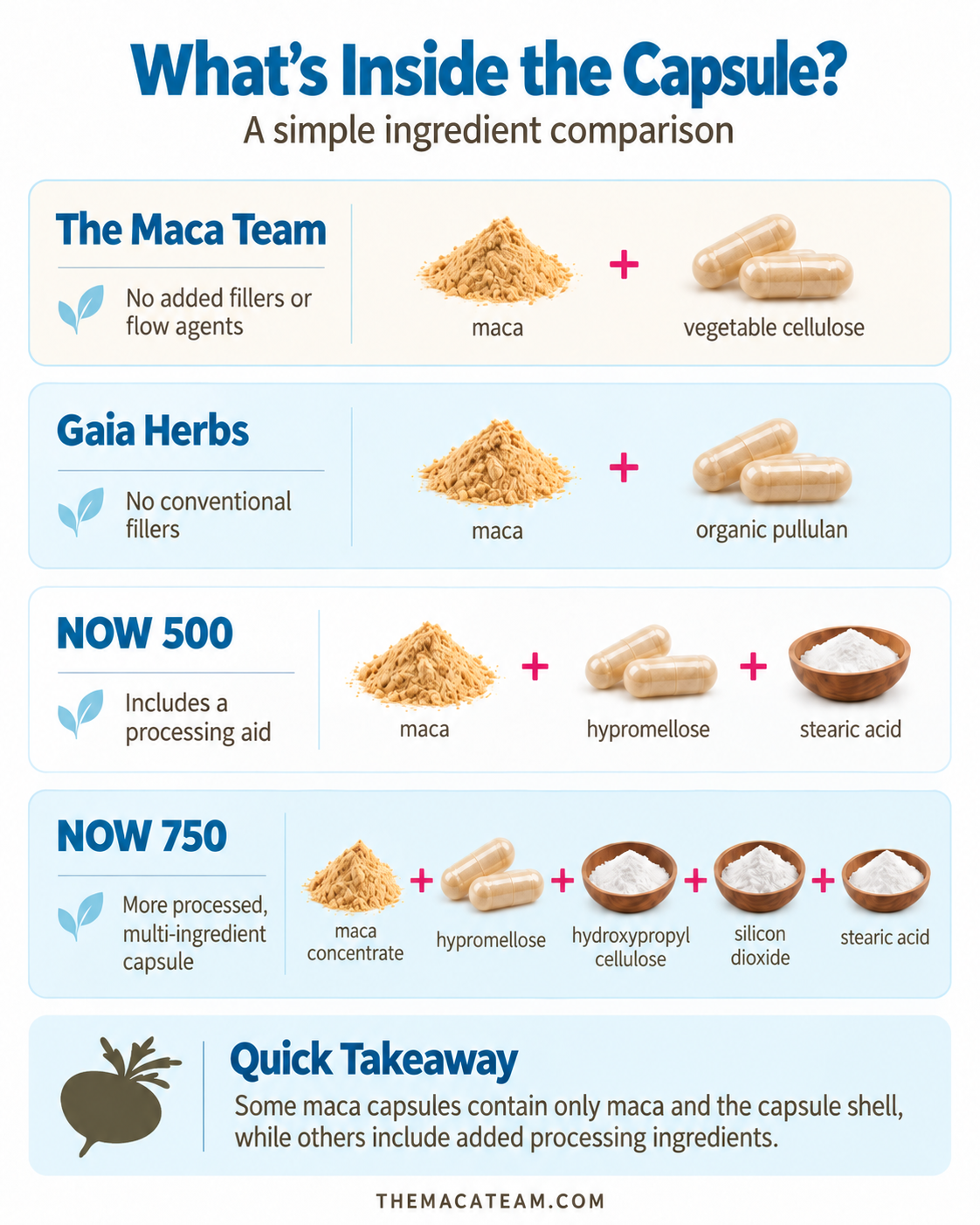
Both our capsules and Gaia’s have especially simple formulations consisting essentially of maca plus the capsule itself.
NOW’s 500 mg product is also relatively simple but includes vegetable-source stearic acid, while its 750 mg concentrated formula contains several additional processing ingredients.
Does a Higher Bottle Price Mean Higher-Quality Maca?
Not necessarily.
Bottle prices are difficult to compare because capsule count, capsule strength and processing differ so much.
To make the price comparison as fair as possible, it helps to start with the whole-root products:
- Gaia Herbs: 60 × 500 mg = 30 grams of maca; price about $21.59
- NOW Foods 500 mg: 100 × 500 mg = 50 grams of maca; price $13.99
- The Maca Team Raw Tri-Color: 200 × 750 mg = 150 grams of maca; price $19.53
- The Maca Team Gelatinized Tri-Color: 200 × 750 mg = 150 grams of maca; price $20.03
The Gaia comparison with our Gelatinized Tri-Color capsules is especially useful because both are organic gelatinized maca products. The Gaia bottle contains about 30 grams of maca, while our bottle contains about 150 grams.
The NOW 750 mg product should be kept outside that simple price-per-gram comparison because it is a 6:1 concentrate. More maca-equivalent material is represented by each gram of the concentrated ingredient, so finished-ingredient weight alone does not measure equivalent potency.
Price also doesn’t tell you everything about organic certification, growing region, processing, ingredient simplicity, freshness, testing or traceability. Those factors should be evaluated separately.
What Should You Look for in High-Quality Maca Capsules?
After working with maca for as long as we have, these are the things we consider most important when evaluating a capsule — whether it’s ours or someone else’s:
- Peruvian origin: Authentic maca has a long agricultural history in the Peruvian Andes.
- Organic certification: This provides independent standards for how the maca is grown and processed.
- Ingredient list: Check whether the capsule contains pure maca or additional fillers, lubricants, binders and flow agents.
- Amount per capsule: 500 mg and 750 mg capsules may look nearly identical but contain different amounts of maca.
- Bottle count: Compare total maca content rather than bottle price alone.
- Processing: Whole-root, raw, gelatinized and concentrated maca are not interchangeable descriptions. Read the Supplement Facts panel and processing details.
- Maca color: If you specifically want red, black, yellow or traditional tri-color maca, make sure the company identifies what is in the product.
- Testing: Look for microbial, heavy-metal, pesticide, purity and identity testing.
- Batch transparency: Public or readily available batch-specific COAs provide stronger evidence than a general statement that a product is “tested.”
- Traceability: A company should be able to tell you where its maca comes from and how it was processed.
So, Which Maca Capsules Are Right for You?
There isn’t one answer that will be right for everyone.
All three companies discussed here offer legitimate maca supplements, but there are meaningful differences depending on what matters most to you.
NOW Foods offers economical maca capsules from a large, established supplement manufacturer. Its 500 mg formula is straightforward but contains vegetable-source stearic acid. Its second 750 mg product is organic and more concentrated, but it also contains hydroxypropyl cellulose, silicon dioxide and stearic acid, and the label describes the ingredient as both raw and gelatinized.
Gaia Herbs offers a particularly clean organic gelatinized whole-root maca capsule with only organic Peruvian maca and an organic pullulan capsule. Its main limitations for maca shoppers are selection and price: the bottle contains 60 capsules and about 30 grams of maca total, and Gaia does not currently offer separate maca colors or raw maca capsules.
Our capsules have a similarly simple formulation — maca plus a vegetable cellulose capsule — but contain 750 mg per capsule and 200 capsules per bottle. We also offer a much broader range of maca colors and processing methods.
Because maca is all we do, we’re able to specialize more deeply in sourcing, processing, color selection and batch testing. We fill our capsules in-house, currently offer 14 capsule varieties and publish current batch-specific testing information directly on our product pages.
For anyone comparing maca capsules, we think the most useful approach is not simply to ask which brand is most recognizable. Look at what is actually inside the capsule, how much maca you receive, where it comes from, whether the processing method fits what you want, how the product was tested, how transparent the company is about the batch you’re buying and what you’re paying for the maca itself.
Conclusion
We hope this comparison makes it a little easier to decide what matters to you when choosing maca capsules.
If you still have questions about maca type, processing, colors, ingredients, or which option might fit your needs, please reach out. Our customer service team works with maca every day and is always happy to help.
Related Reading
Interested in Trying Maca Capsules?
We offer organic Peruvian maca capsules in multiple colors and processing styles, all filled in-house without added fillers or flow agents.