
Maca History
By Mark Ament, M.A. | Updated on
Reviewed by TMT editorial board
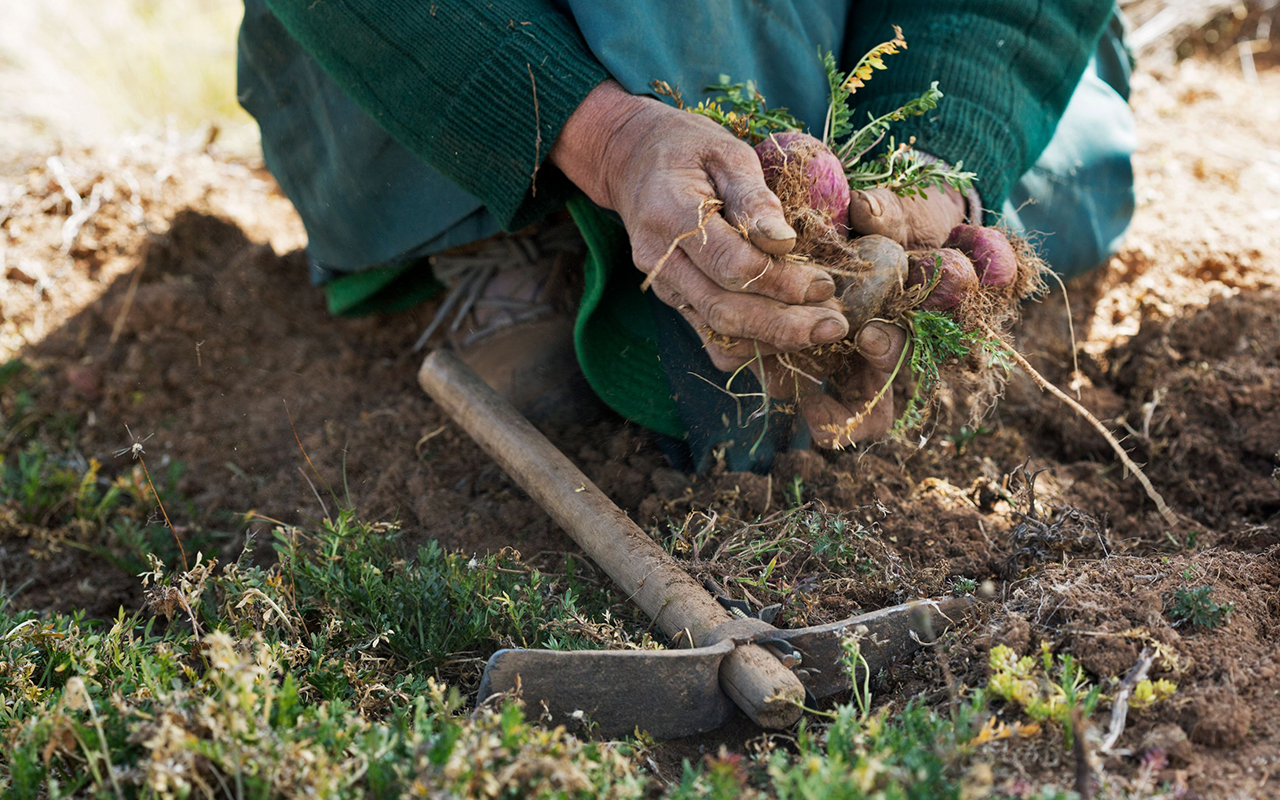
Maca's history begins in the high Andes of central Peru, where the root became part of local food, farming, and cultural life.
Maca is often described today as a superfood, but its real history is older, more regional, and more interesting than that word suggests. Long before maca became known outside Peru, it was a high-Andean food crop shaped by altitude, cold, wind, Indigenous farming knowledge, trade, ritual, colonial tribute records, botanical research, and modern global demand.
At the center of maca's story is a difficult landscape: the puna of central Peru, especially the highland zones of Junín and Pasco, around Lake Junín, also known historically as Chinchaycocha, and the Bombón Plateau. Several historical and ethnobotanical sources place maca in this high-Andean region, with cultivation commonly described at elevations around 3,800 to 4,500 meters above sea level.
To understand maca's history, we have to begin not with the root itself, but with the world that produced it.
Quick Summary
- Maca is a traditional high-Andean crop from central Peru, especially Junín and Pasco.
- Its historical heartland includes Lake Junín / Chinchaycocha, the Bombón Plateau, San Blas, Ondores, Carhuamayo, Ninacaca, Huayre, Vicco, and surrounding highland communities.
- Before maca became a powder, capsule, or extract, it was a food: dried, stored, cooked, roasted, exchanged, and used in traditional preparations.
- Colonial records describe maca as a crop, tribute item, barter food, and root of the cold highlands.
- Maca's history includes both documented facts and traditional beliefs about warmth, vitality, endurance, and fertility.
- Modern maca history also includes scientific naming debates, renewed research, global demand, and questions about Peruvian origin and sourcing.
How We Know the History of Maca
The history of maca comes from several kinds of evidence, each with its own strengths and limits.
Some of the evidence is archaeological and ethnobotanical, helping us understand how long people have lived in the high Andes and how crops, tubers, and camelids supported life in the puna. Some comes from colonial visitas, tribute records, and Spanish chroniclers, which show maca as a named crop, food, barter item, and tax obligation in the 16th and 17th centuries. Other evidence comes from Peruvian agronomic and botanical studies from the 20th century, especially the work of Gloria Chacón de Popovici, Ramón Solís Hospinal, Ramiro Matos, Peter Vílchez, and other researchers who examined maca's cultivation, classification, and cultural role.
This matters because not every claim about maca has the same kind of support. Some parts of maca's history are well documented. Others are probable but still debated. Still others belong to traditional belief, oral memory, colonial interpretation, or later commercial retelling.
Well Documented
Maca was cultivated in the cold highland regions of central Peru, especially Junín and Pasco. It appears in colonial records as food, tribute, and barter. It was dried, stored, and associated with the harsh puna environment where many other crops did not grow well.
Likely but Debated
The exact date and place of maca domestication are not fully settled. Several sources point to the high Andes of Junín, often near San Blas, and suggest domestication roughly 1,300 to 2,000 years ago.
Traditional Belief
Maca has long been associated with fertility, vitality, warmth, endurance, and sexual energy. These beliefs are historically important, but they should be read as traditional and cultural claims unless supported separately by modern research.
The High-Andean World Where Maca Began
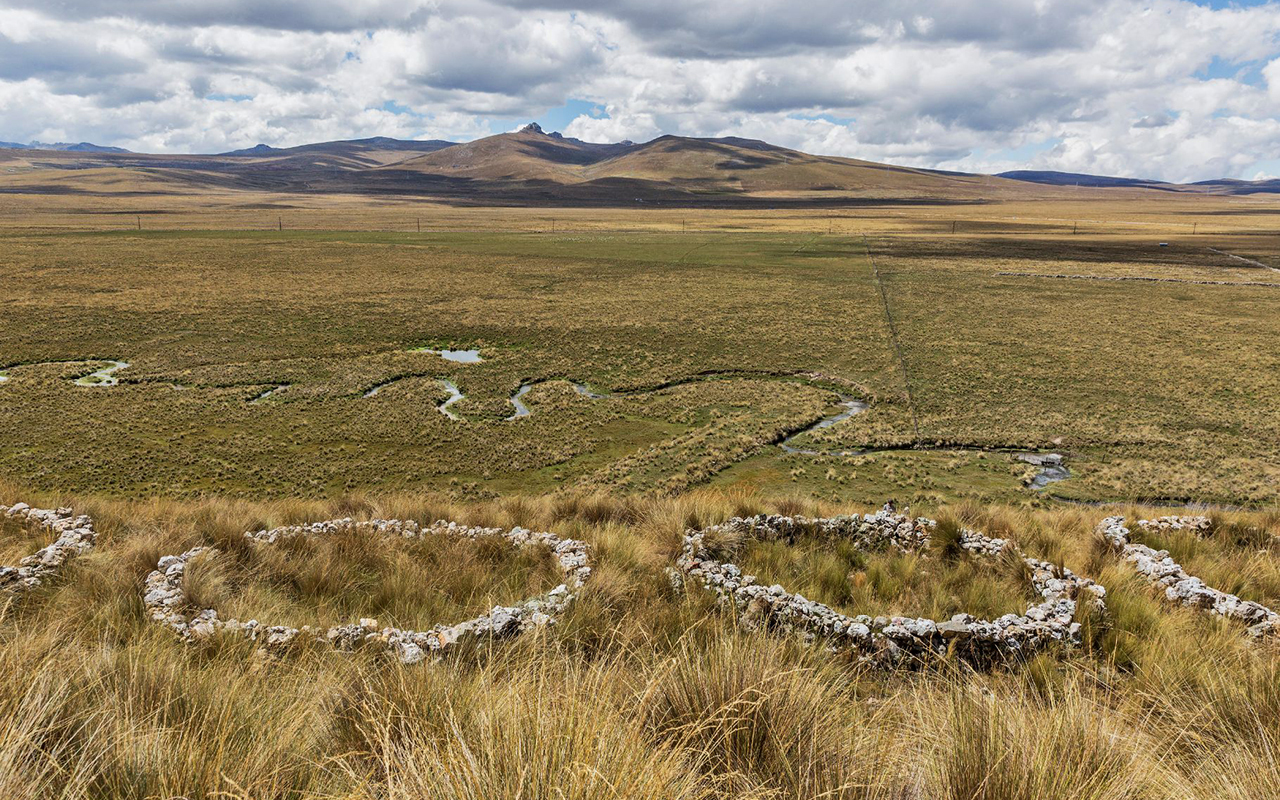
Maca's historical identity is inseparable from the high, cold puna of central Peru.
Maca belongs to one of the most demanding agricultural environments in the world. The central Peruvian puna is high, cold, windswept, and exposed. In this environment, many familiar crops cannot grow reliably. The historical importance of maca comes partly from the fact that it could be cultivated where maize, wheat, and many other food plants were limited or absent.
Ramón Solís Hospinal places maca in the high Andean puna near Lake Chinchaycocha and the Bombón Plateau, describing it as a crop of roughly 3,800 to 4,500 meters above sea level. Ramiro Matos likewise described maca as a genuinely Andean plant and an important response of Andean culture to the challenge of the cordillera.
In this sense, maca's history is also a history of adaptation: people adapting to the high Andes, crops adapting to harsh growing conditions, and communities developing food systems suited to landscapes that outsiders often saw as marginal.
Maca's Historical Heartland
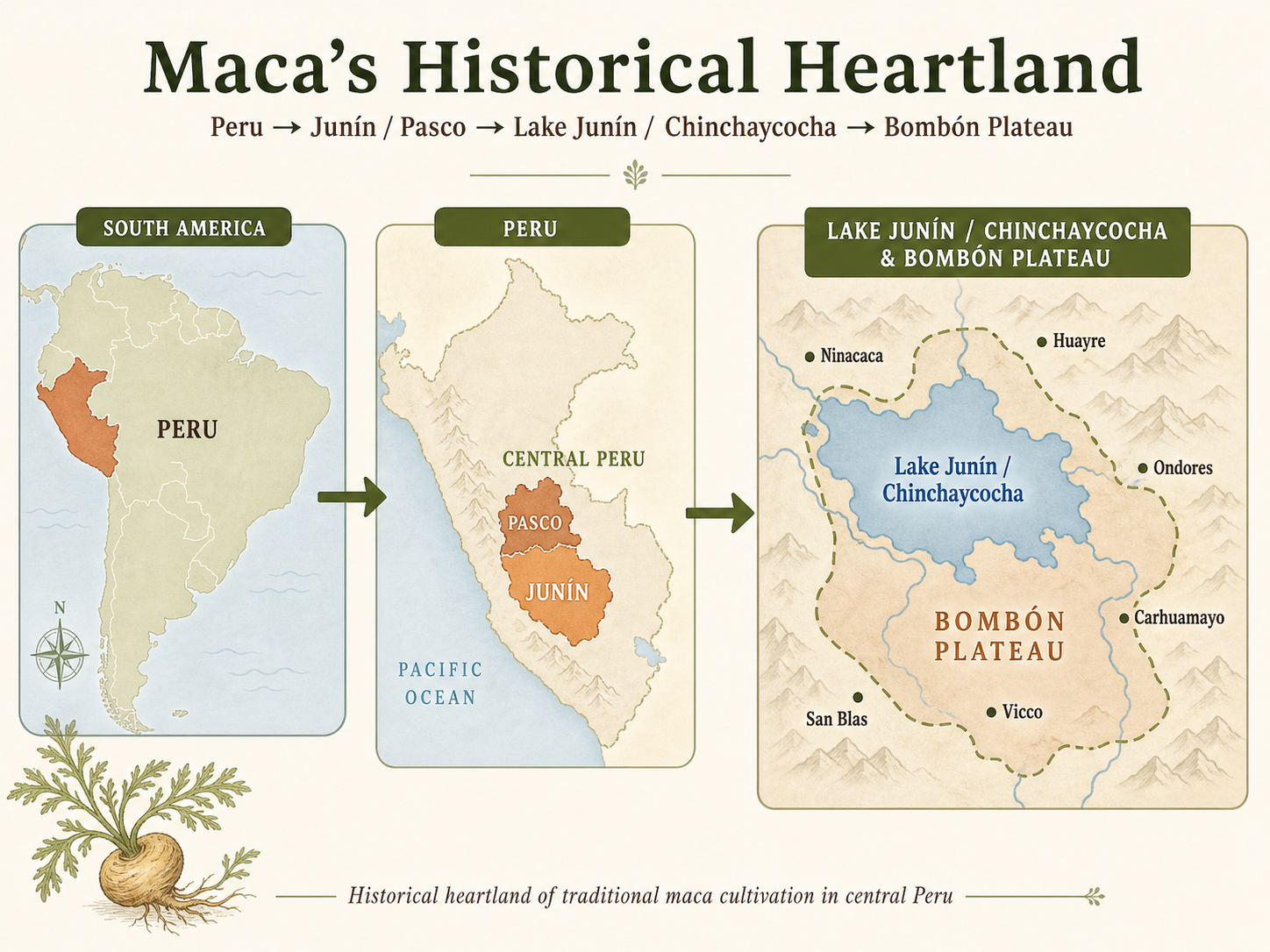
Maca's historical heartland is centered in the highland regions of Junín and Pasco, especially around Lake Junín / Chinchaycocha and the Bombón Plateau.
Maca's historical heartland is not simply "Peru" in a general sense. It is much more specific:
Central Peru → Junín and Pasco → Lake Junín / Chinchaycocha → Bombón Plateau → San Blas, Ondores, Carhuamayo, Ninacaca, Huayre, Vicco, and nearby highland communities.
This geographic specificity is one reason Peruvian maca is not simply interchangeable with maca grown elsewhere. Maca's history is tied to a particular altitude, climate, soil, and cultural landscape.
Before Maca: People, Camelids, and Life in the Puna
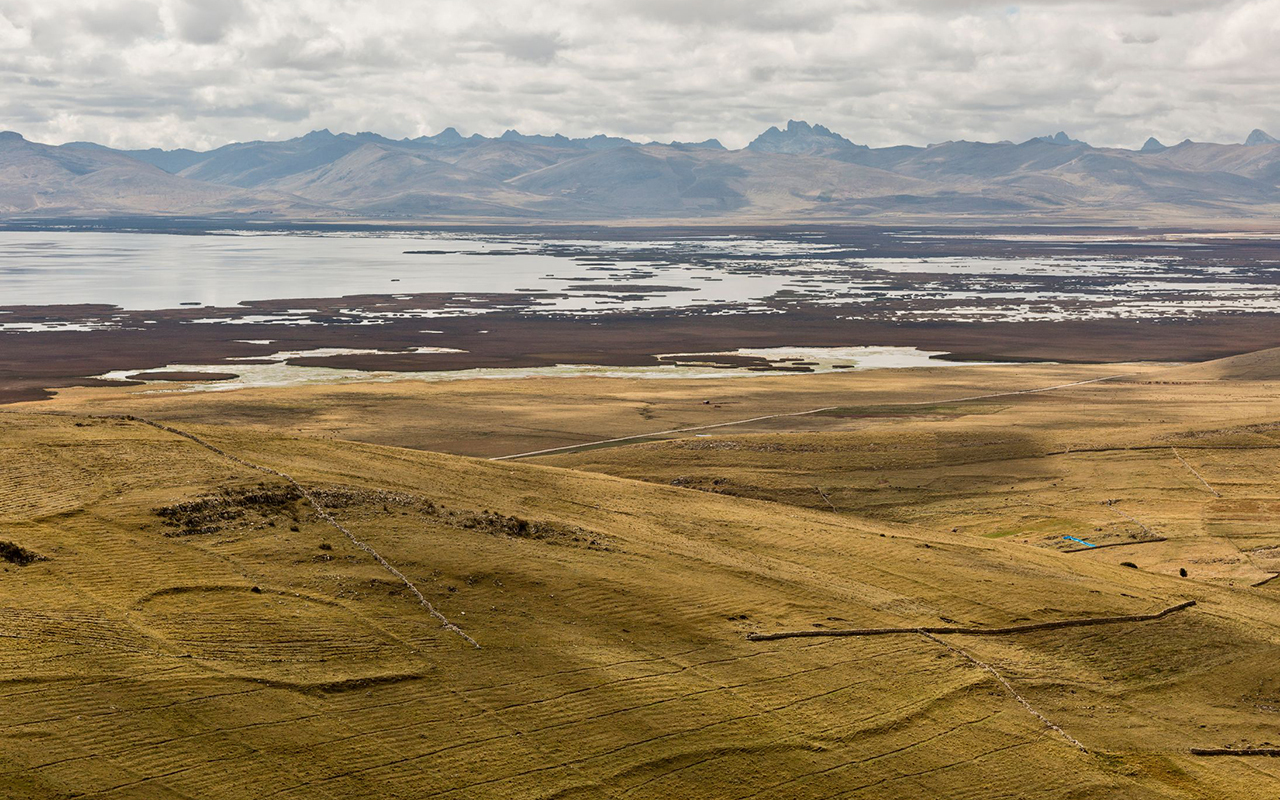
Lake Junín / Chinchaycocha and the surrounding puna form part of the historical landscape associated with traditional maca cultivation.
The central Andes were occupied long before maca appears clearly in written records. Some historical summaries place early human occupation in the Central Andes between roughly 20,000 and 10,000 B.C., followed by a transition toward the use and domestication of South American camelids between about 7,000 and 5,500 B.C.
This is important background because maca developed within a wider highland system. The puna was not only a place of crops. It was also a place of llamas, alpacas, wild resources, seasonal movement, exchange, and ecological specialization.
Maca should therefore be understood as part of a broader Andean achievement: learning how to live in and organize food production across sharply different ecological zones.
The Domestication of Maca
The exact origin of maca cultivation is still debated. Some authors place its domestication in the high-Andean region of Junín, possibly near San Blas. Solís states that ancient peoples of Chinchaycocha and the Tarma culture gave major importance to maca cultivation and that domestication would have taken place in the San Blas area of Junín.
Secondary sources are cautious but broadly similar. Hermann and Heller state that maca was probably domesticated in San Blas, Junín, between 1,300 and 2,000 years ago, while noting that little is known about its exact origin. Other secondary material cites the position that maca domestication began at least 2,000 years ago around San Blas, Junín.
That cautious framing is important. The best historical reading is not that we know every detail of maca's beginning, but that the evidence consistently points to a high-Andean origin, most strongly associated with central Peru, Junín, Pasco, Chinchaycocha, San Blas, and the Bombón Plateau.
Maca Before the Incas: Pumpush, Yaros, Tarma, and Chinchaycocha
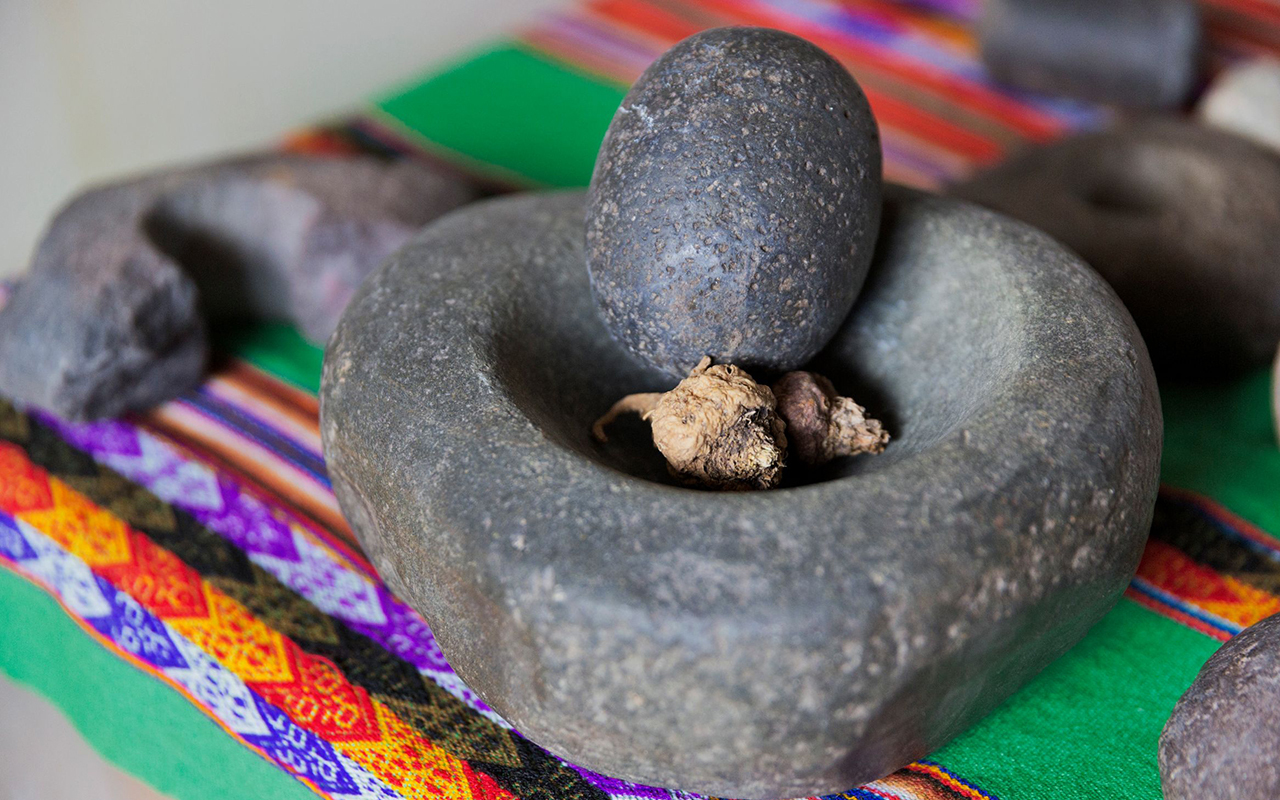
Maca's pre-Inca history is tied to highland peoples, traditional tools, cultivation, exchange, and daily food use.
Before maca became part of the Inca world, it was associated with earlier highland peoples. Solís connects maca with ancient inhabitants of Chinchaycocha, the Tarma culture, the Yaros, and the Pumpush or Pumpus. According to Solís, the Yaros cultivated maca in large extensions in the upper puna, while the Pumpus later domesticated maca, cultivated it widely, and used it for food and barter with neighboring cultures.
This is one of the most important parts of maca history because it moves the story beyond the common phrase "used by the Incas." Maca was not simply an Inca crop. It appears to have belonged first to older highland systems of cultivation, exchange, and survival.
The place names matter too: San Blas, Bombomarca, Pumpu, Chinchaycocha, Guanuco Pampa, Yarus, and the Bombón Plateau appear repeatedly in the historical material. These names help anchor maca in a real geography and a real cultural landscape, rather than in a vague idea of "ancient Peru."
Maca in the Inca World
By the time of Inca expansion, the Bombón Plateau had become strategically important. Solís describes Bombón as a political and strategic support point linking Cusco and Cajamarca, and suggests that the Inca state valued and adapted older pre-Inca agricultural experience in the region.
Maca appears to have functioned as both food and exchange crop. Solís cites a 1572 visit of León de Huánuco stating that maca had been used in Inca times as a means of exchange or barter among Inca peoples and puna inhabitants. He also records that maca was offered to Andean deities together with maize and potatoes, showing that maca belonged not only to food economy but also to ritual and symbolic life.
Some later sources also connect maca with Inca warriors, vitality, and military life. These accounts are part of maca's traditional reputation, though they should be read as historical tradition rather than direct proof of modern effects. Whether all of these stories can be verified in detail or not, they show that maca's reputation was never limited to taste or calories. It was remembered as a food associated with endurance, fertility, warmth, and life in the most difficult highland environments.
Maca as Daily Food, Barter Crop, and Stored Root
One of the strongest themes in the historical record is that maca was used as food. Pulgar Vidal, cited by Solís, described maca in the past as a daily food, used "like bread," with families producing enough for their own annual use while people from other areas obtained it through barter.
This is a crucial point. Before maca was a supplement, powder, capsule, or extract, it was a stored food. It could be dried, kept, exchanged, and prepared in different ways. Solís also connects maca with storage systems, noting that Guanuco Pampa stored tubers such as potato and maca, and that storage helped support economic stability.
The ability to dry and store maca would have made it especially valuable in a highland world shaped by seasonality, distance, and ecological exchange. Maca was not simply harvested and eaten fresh. It belonged to a wider Andean pattern of preservation, storage, transport, and trade.
How Maca Was Traditionally Prepared and Eaten
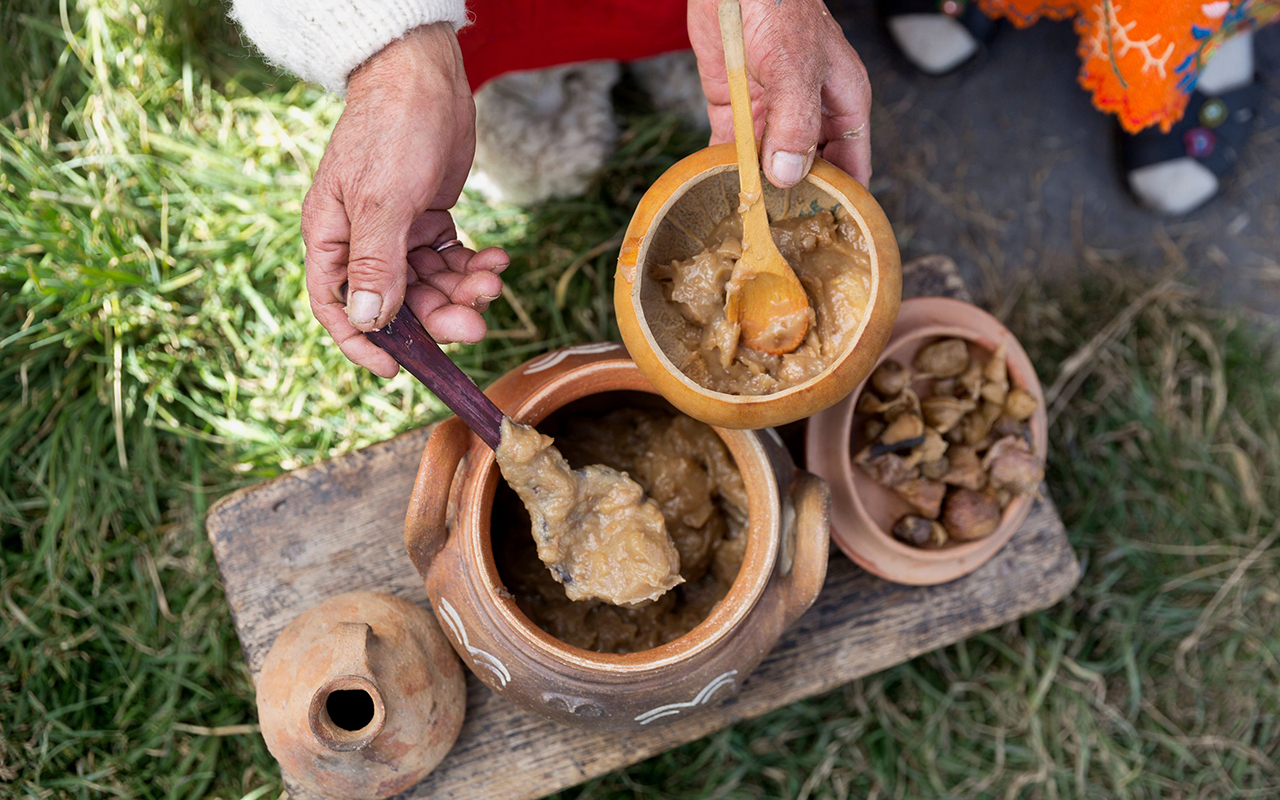
Long before maca became a modern supplement, it was prepared as food in drinks, porridges, broths, mazamorra, and other traditional dishes.
Historical and ethnobotanical sources describe maca first as a food. Fresh maca could be cooked, roasted, or boiled. Dried maca could be stored and later prepared in porridges, drinks, broths, and other dishes.
Some sources describe fresh maca being cooked in earth ovens, while dried roots could be stored for years until needed. Traditional preparations include mazamorra, a sweet porridge-like dish made by boiling maca in water or milk, as well as maca drinks, broths, juices, porridges, and combinations with foods such as quinoa, milk, fruit, soy, and honey.
This food history is important because it gives maca a more grounded identity. Maca was not historically consumed as an isolated extract or capsule. It was part of daily food culture, household preparation, seasonal storage, and local cuisine.
The First Written Records of Maca
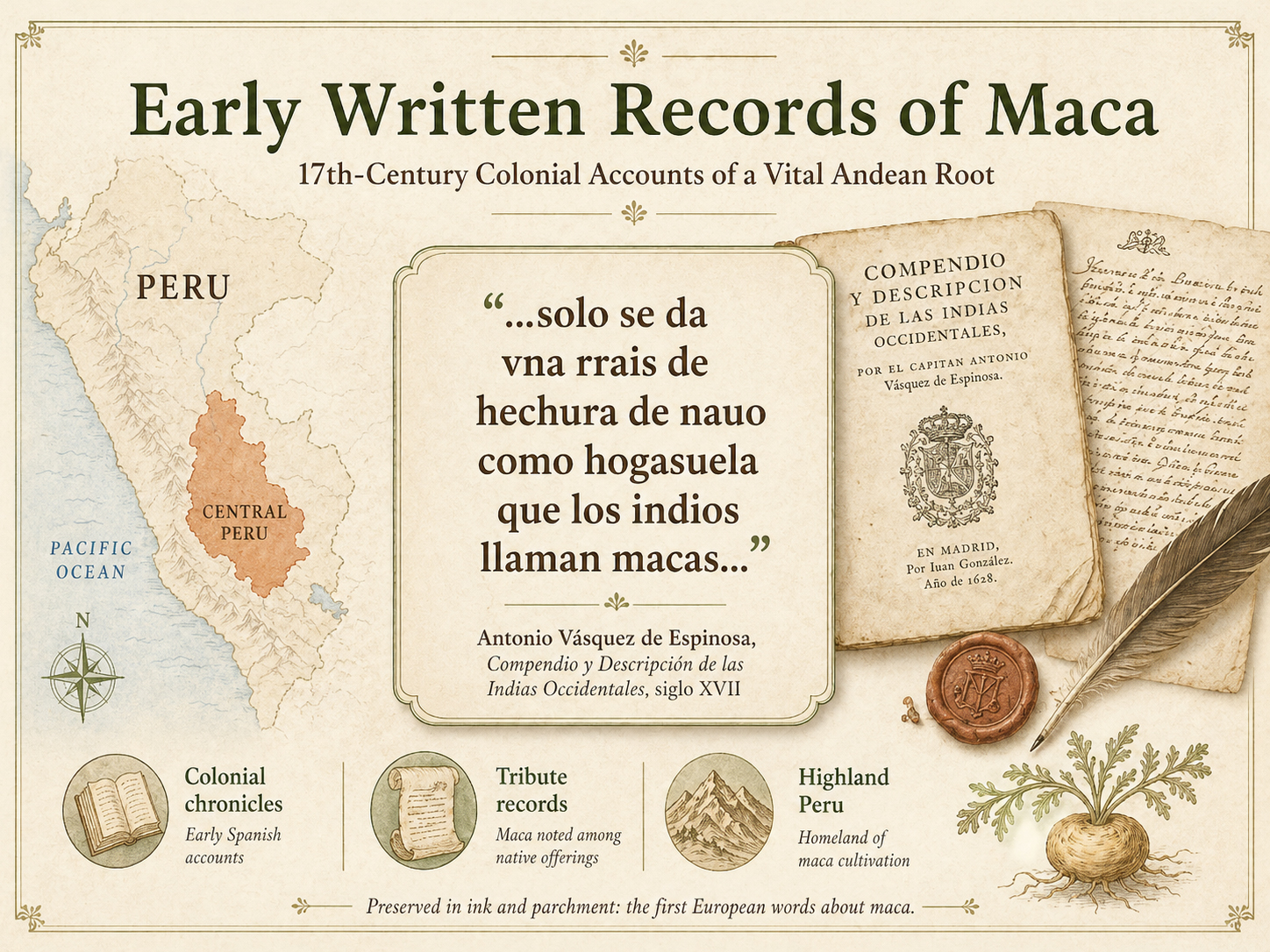
Colonial visitas, tribute records, and chronicles provide some of the clearest written evidence for maca's historical role in the Andes.
The earliest written references to maca come from colonial sources, including visitas, tribute documents, and chronicles. These sources are valuable because they show maca as a real crop in highland life, not merely a later legend.
Several colonial records mention maca directly or indirectly in relation to Chinchaycocha, Huánuco, Canta, and other highland regions. In the 1549 Canta material published by María Rostworowski, the town of Causso is described as a place where maize, wheat, and potatoes did not grow, but maca did. The record states that the people resided there because of maca and because of sheep herding.
In the 1562 visit of the province of León de Huánuco, Ortiz de Zúñiga records maca among the crops grown and exchanged by highland communities. The text describes people taking maize and beans to Chinchacocha and the Yaros and bringing back wool, fish, charqui, animals, and other goods, while also listing maca among the cultivated foods of the region.
The tribute records are especially striking. In the Chinchaycocha encomienda of Juan Tello, the people were required to provide 300 loads of maca each year, each load being half a fanega, along with 100 loads of potatoes. Later in the same tribute material, maca appears again as part of the food obligations owed for the support of a cleric or religious teacher.
These records show that maca had economic weight. It was not an obscure plant. It was counted, demanded, transported, stored, and used as tribute.
Maca in Colonial Chronicles
Colonial chroniclers also described maca. Antonio Vásquez de Espinosa wrote of Chinchacocha as a very cold province where no trees, maize, or wheat grew, but where a turnip-shaped root called "macas" was produced. He also repeated the belief that maca had a "hot" quality and that land where it was planted could be exhausted for many years.
Bernabé Cobo, writing in the 17th century, gave one of the best-known colonial descriptions. He described maca as a root found in the province of Chinchacocha, growing in the harshest and coldest parts of the sierra, where other cultivated food plants did not grow. He wrote that maca served the people "as bread," green and dried, and that it could be eaten cooked, roasted, or dried.
Hipólito Ruiz, writing from the botanical expedition period of the late 18th century, also described maca near Ondores, Carhuamayo, Ninacaca, and other towns near Lake Junín. His account again places maca in the cold highlands, where few other crops were cultivated.
Together, these colonial and early botanical sources establish several consistent points: maca was a highland crop; it was associated with very cold regions; it was used as food; it could be dried and stored; and it carried a strong reputation for warmth, vitality, and fertility in local and colonial imagination.
A Note on Traditional Beliefs
Many historical sources describe maca through older ideas of warmth, strength, fertility, endurance, and vitality. These accounts are important for understanding maca's cultural reputation, but they should not all be read as modern scientific claims. In this article, we treat them as part of maca's historical and cultural record.
Traditional Beliefs Around Maca
Maca's historical reputation included much more than ordinary nutrition. In Andean tradition and colonial-era writing, it was often associated with fertility, heat, vitality, and strength. These beliefs appear in multiple sources, although they should be understood as cultural and historical claims rather than modern medical proof.
Ramiro Matos discusses myths and taboos surrounding maca, including the idea that young unmarried women should not consume it because of its reputed fertility properties, and that young men should avoid it because it might make them lustful. He also notes that herbalists and traditional healers used maca in relation to conditions associated with "cold," while other writers emphasized its supposed aphrodisiac properties.
Solís includes similar material, recording rural beliefs that maca improved fertility and was connected with masculine and feminine hormones, though those statements belong to traditional belief and older interpretations rather than current clinical language.
These beliefs are historically important because they show how maca was understood within Andean categories of food, warmth, strength, reproduction, and survival. Even where the claims cannot be accepted literally, they help explain why maca became such a culturally powerful plant.
Maca, Animals, and the Spanish
Another recurring historical theme is maca's association with animals. Several sources report that Spanish colonists noticed difficulties with livestock reproduction in the highlands and turned to maca after learning of its reputation among Indigenous people.
The National Research Council's Lost Crops of the Incas states that after the Conquest, the Spanish found that their livestock reproduced poorly in the highlands and that Indigenous people recommended maca. Hermann and Heller repeat a similar account, describing the Spaniards' concern about horses and other animals in the puna of Junín and maca's reputation as a crop connected with nutrition and fertility.
These stories should be treated carefully, but they are part of the historical record of maca's reputation. They also help explain why maca appears in tribute systems and why Spanish administrators paid attention to it.
Decline After the Conquest
Despite its importance, maca cultivation appears to have declined after the Spanish conquest and during later colonial and republican periods. Gloria Chacón de Popovici writes that during the Colonial and Republican periods, maca production decreased, although growers continued to use it in barter.
Vílchez also connects the decline of maca cultivation with broader colonial changes: the introduction of European crops and animals, the focus on mining, and the pressure of forced labor systems.
This decline is an important part of the story. Maca survived not because it remained central to official colonial or national agricultural policy, but because highland communities continued to grow it, store it, exchange it, and remember its value.
Scientific Naming: Lepidium meyenii and Lepidium peruvianum
Modern maca history also includes a botanical naming debate. Many scientific and commercial sources use the name Lepidium meyenii Walp. Other sources, especially those following Gloria Chacón de Popovici, use Lepidium peruvianum Chacón.
According to Chacón's work, she identified and described Lepidium peruvianum Chacón sp. nov. in 1990 after comparing material considered to be maca with Lepidium meyenii and Lepidium gelidium. Her systematic section places the plant in the Cruciferae / Brassicaceae family, genus Lepidium, species Lepidium peruvianum Chacón sp. nov.
Hermann and Heller discuss the taxonomic issue as well. They note that Chacón questioned the status of the cultivated Andean Lepidium as L. meyenii and proposed L. peruvianum based on morphological comparison and herbarium study. They also state that the name change seemed justifiable, while acknowledging that further taxonomic research was needed.
For readers, the simplest way to explain this is: Lepidium meyenii is still widely used, while Lepidium peruvianum appears in sources that distinguish cultivated Peruvian maca from earlier or broader Lepidium classifications. The debate itself is part of maca's modern scientific history.
Rediscovery, Research, and Modern Revival
By the 20th century, maca had become a crop of renewed scientific and commercial interest. Chacón reports that when she first traveled to Huancayo in 1960, she was told she had to go to San Juan de Jarpa and then up to 4,300 meters above sea level to find the plant. She also wrote that during her early research she found no prior scientific study or botanical classification of maca in the institutions she consulted.
Solís, Chacón, Matos, Vílchez, Hermann, Heller, and others show that the late 20th century was a period of renewed attention: botanical description, nutritional analysis, agronomic study, animal studies, and growing concern that native Andean crops had been neglected.
By the late 20th and early 21st centuries, maca had moved far beyond the puna. It became a Peruvian export crop, a health food ingredient, and a global supplement. That modern popularity brought new opportunities for growers and researchers, but also new questions: Where was the maca grown? Was it Peruvian? Was it cultivated traditionally? How was it dried and processed? Was the market respecting the crop's cultural and geographic origins?
Those questions are now part of maca's history too.
A Brief Timeline of Maca History
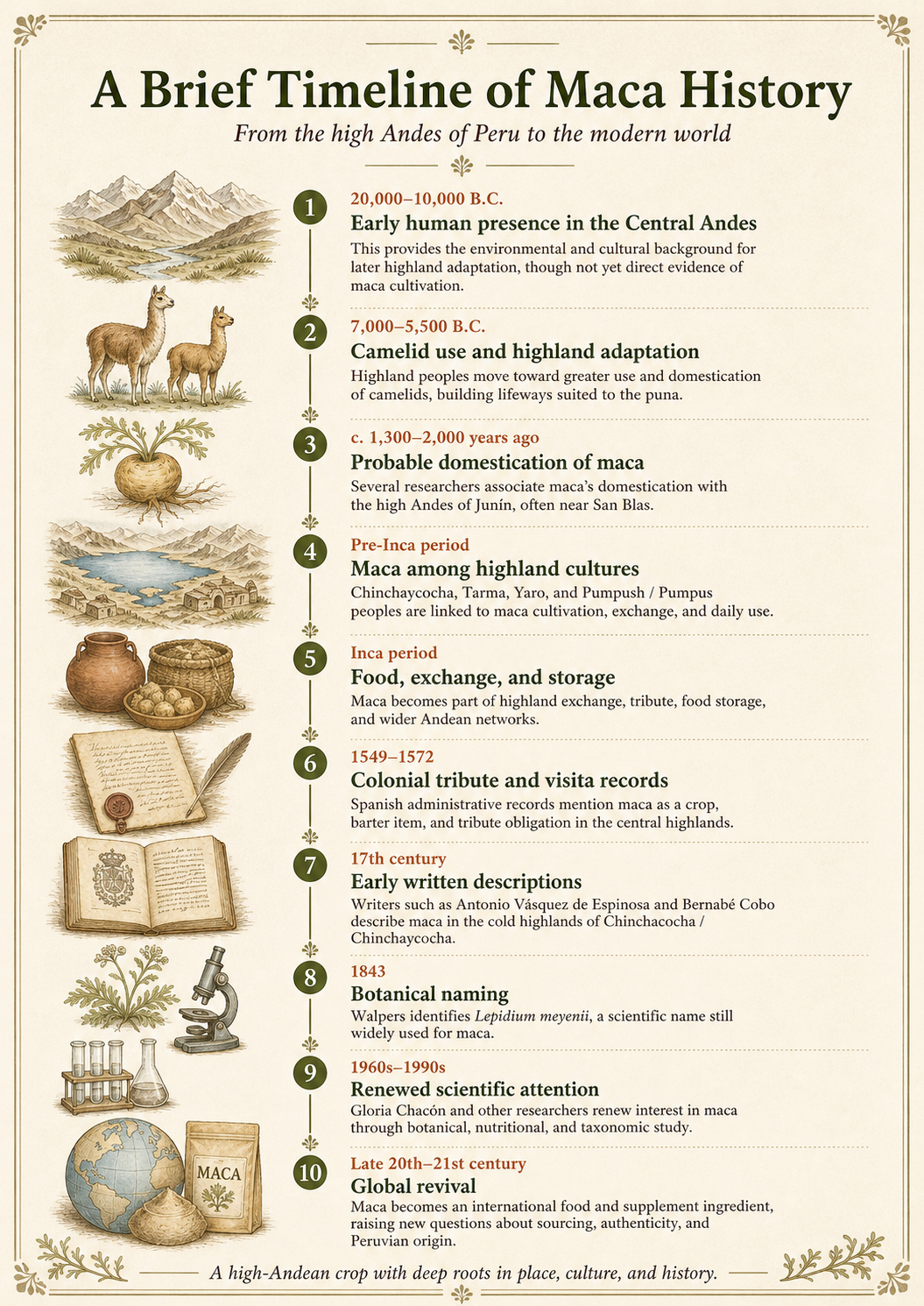
A brief timeline of maca history, from early high-Andean background to colonial records, botanical study, and modern global interest.
Why Peruvian Origin Still Matters
Maca's history is inseparable from place. The crop's traditional identity is tied to the high-altitude puna of central Peru, especially Junín and Pasco. Its story includes Indigenous agricultural knowledge, specific growing regions, local preparation methods, and generations of farmers who continued cultivating it even when outside economies gave more attention to mining, European crops, and export agriculture.
As maca became popular globally, it also became easier to separate the product from its origin. Modern consumers may see maca only as a powder, capsule, or extract. But historically, maca was a regional Andean crop connected to altitude, soil, climate, storage, trade, and local foodways.
That is why sourcing matters. A serious understanding of maca should ask not only what maca is, but where it was grown, how it was handled, and whether its production respects the cultural and agricultural tradition that made maca possible in the first place.
Why Maca's History Still Matters
Maca's history changes how we see the root. It is not just a supplement ingredient or a trend from the natural products industry. It is a high-Andean food crop with deep roots in place, altitude, Indigenous knowledge, exchange networks, colonial records, botanical debate, and modern global trade.
The oldest sources do not present maca as a modern "superfood." They present it as something more concrete: a root that grew where little else could grow, a daily food for highland communities, a crop used in barter and tribute, a plant surrounded by strong beliefs, and a symbol of Andean adaptation to one of the world's most demanding agricultural landscapes.
To understand maca well, we have to understand the puna, the people who cultivated it, the records that preserved its name, and the communities that kept growing it long after outside systems overlooked it.
Continue Reading the Maca Guide
The history of maca is only one part of understanding the root. For a broader view, explore the rest of our guide covering benefits, how maca works, comparisons, and who maca may be a fit for.
Maca Guide
Your starting point for the full guide.
Maca Benefits
A broader look at why people use maca.
How Maca Works
A practical look at compounds, nutrients, and why effects may differ.
Maca Comparisons
Raw vs. gelatinized, colors, forms, and other key differences.
Maca History
Traditional use, cultivation, and Peruvian background.
Who Is Maca For?
A practical overview of who may be interested in maca.
Common Questions About Maca History
Where did maca originate?
Maca is most closely associated with the high-Andean regions of central Peru, especially Junín and Pasco, around Lake Junín / Chinchaycocha and the Bombón Plateau.
How long has maca been used?
The exact beginning of maca cultivation is still debated, but several sources associate maca domestication with the high Andes of Junín roughly 1,300 to 2,000 years ago, with older highland occupation forming the broader cultural background.
Was maca used by the Incas?
Yes, maca appears in historical accounts connected with Inca-period food, exchange, tribute, and storage systems. However, some popular stories about Inca warriors and maca should be understood as traditional accounts rather than fully documented historical fact.
What are the earliest written records of maca?
Some of the clearest early written records come from Spanish colonial visitas, tribute documents, and chroniclers such as Antonio Vásquez de Espinosa and Bernabé Cobo, who described maca in the cold highlands of Chinchacocha / Chinchaycocha.
References and Further Reading
The following sources informed this historical overview. Some are primary colonial sources, while others are modern ethnobotanical, agronomic, archaeological, and historical studies.
- Cabieses, Fernando. La maca y la puna. Lima: Universidad de San Martín de Porres, Escuela Profesional de Turismo y Hotelería, 1997.
- Chacón de Popovici, Gloria. La importancia de Lepidium peruvianum Chacón (“Maca”) en la alimentación y salud del ser humano y animal: 2,000 años antes y después de Cristo y en el siglo XXI. Lima, Peru, 1997.
- Cobo, Bernabé, SJ. Historia del Nuevo Mundo. Tomo I. Madrid: Atlas, 1956.
- Hermann, Michael, and Joachim Heller. Andean Roots and Tubers: Ahipa, Arracacha, Maca and Yacon. Rome: Institute of Plant Genetics and Crop Research, 1997.
- Matos, Ramiro. “La maca: una planta peruana en extinción.” Arqueología y Vida, No. 3, 2010.
- National Research Council. Lost Crops of the Incas: Little-Known Plants of the Andes with Promise for Worldwide Cultivation. Washington: National Academy Press, 1989.
- Ortiz de Zúñiga, Iñigo. Visita de la provincia de León de Huánuco en 1562. Edited by John Murra. Huánuco: Universidad Nacional Hermilio Valdizan, 1972.
- Rostworowski, María. “Las visitas de Canta de 1549 y de 1553.” In Señoríos indígenas de Lima y Canta. Lima: IEP, 1978.
- Ruiz, Hipólito. Relación histórica del viage, que hizo a los reynos del Perú y Chile. Madrid: Talls. Gráfs. Bermejo, 1952.
- Solís Hospinal, Ramón. Producción de maca en la meseta de Bombón. Huancayo, Perú: Imprenta Ríos, n.d.
- Vásquez de Espinosa, Antonio. Compendio y Descripción de las Indias Occidentales. Washington: Smithsonian Institution, 1948.
- Vílchez, Peter. El cultivo de la maca y su consumo. Lima: CONCYTEC, 2001.