
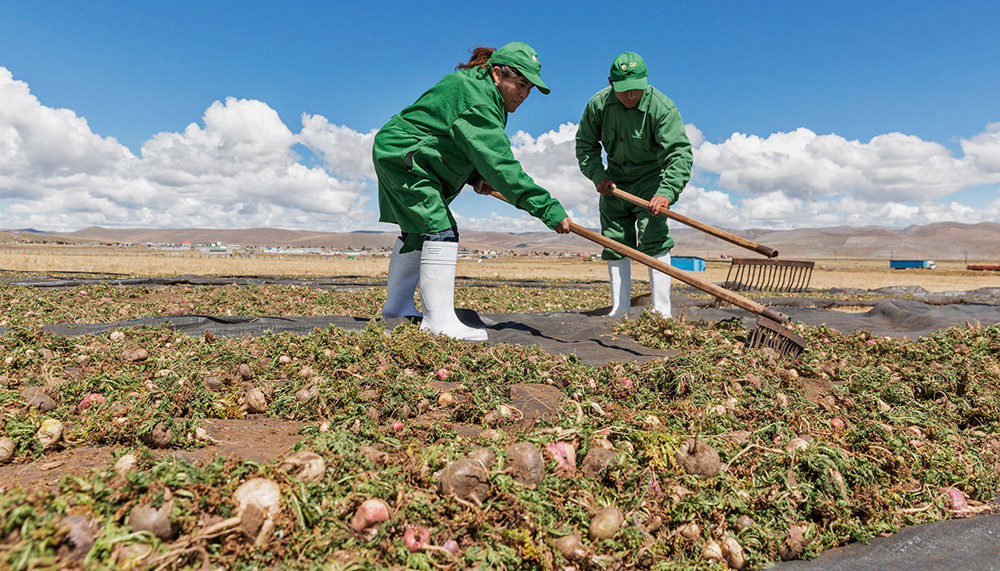
Gelatinized vs Fermented Maca: What’s the Real Difference?
Last updated: March 2026
This article is based on field observations in Peru, supplier documentation, standard food science principles related to starch gelatinization, and our ongoing work with Peruvian maca growers and processors.
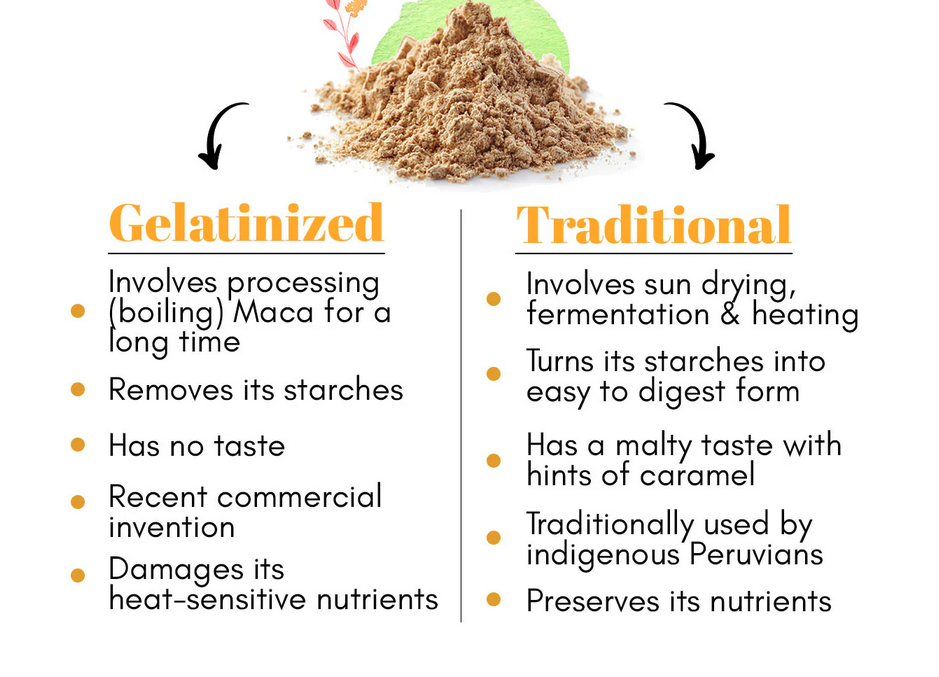
A recently circulated graphic comparing “gelatinized” and “traditional” maca contains several oversimplified or inaccurate claims. This article explains what the processing methods actually involve.
Recently, a customer brought to our attention a graphic circulating online that compares “gelatinized” maca to “traditional” maca. While visually appealing, it contains several inaccuracies and misleading claims.
This article breaks down what gelatinization really is, how maca has actually been prepared traditionally, and what the science shows.
Key Takeaways
- Gelatinization does not remove starch from maca. It changes the starch structure, making it easier to digest.
- Traditional maca was generally sun-dried and then cooked, not eaten raw.
- Fermented maca is a modern processing approach, not a traditional Andean preparation method.
- Controlled gelatinization is a short heat process, not extended boiling of whole roots.
- Most nutrients remain largely intact, although some heat-sensitive components such as vitamin C are reduced.
What Is Gelatinized Maca?
Gelatinization is a controlled heating process applied to dried maca root powder to improve digestibility.
What actually happens:
- Maca is heated to approximately 65°C–75°C (149°F–167°F)
- The process typically lasts 5–15 minutes
- It is not prolonged boiling of whole roots
This is a precise, short-duration process, not the extended “boiling for a long time” often claimed.
In food science, starch gelatinization is a well-established process in which heat and moisture disrupt the native structure of starch granules, making them easier to digest. For a general scientific overview, see this PubMed search on starch gelatinization.
Does Gelatinization Remove Starch?
No.
This is one of the most common misconceptions.
- Gelatinization does not remove starch
- Instead, it alters starch molecules, making them easier to digest
- The starch is still present — it’s simply in a form that the body can process more efficiently
Does Gelatinized Maca Have No Taste?
Also incorrect.
Gelatinized maca has a distinct flavor profile, often described as:
- Nutty
- Earthy
- Slightly caramel-like
In fact, many people find gelatinized maca more palatable than raw maca.
Is Gelatinization a “Modern Invention”?
Partially true — but misleading without context.
- The modern industrial gelatinization process was developed in the early 20th century
- However, similar effects have been achieved for thousands of years through traditional preparation
Historically, maca was almost never consumed raw. It was typically:
- Boiled
- Cooked into porridges
- Added to soups and drinks
So while the modern method is standardized, the underlying principle is not new.
Does Gelatinization Damage Nutrients?
This is often overstated.
Based on repeated side-by-side analysis:
- Vitamin C is reduced (heat-sensitive)
- Enzymes are deactivated
- Most other nutrients remain stable
In practical terms, minerals, fiber, and maca’s characteristic compounds are largely retained during controlled gelatinization.
Gelatinized vs Fermented Maca: Quick Comparison
| Feature | Gelatinized Maca | Fermented Maca |
|---|---|---|
| Process | Heat + moisture | Microbial fermentation |
| Traditional? | Not in modern form, but based on traditional cooking principles | No, not as a traditional Andean processing method |
| Effect on starch | Starch is altered, not removed | Some components may be partially broken down |
| Digestibility | Improved for many people | May also be improved |
| Nutrient impact | Some heat-sensitive loss | Variable depending on process |
| Flavor | Nutty, earthy, slightly caramel-like | Can vary depending on method |
What About “Traditional” Maca Processing?
There are also several inaccuracies in how “traditional” methods are described.
Sun-Drying: Accurate
Traditionally, maca roots are:
- Harvested and sun-dried after harvest
- Dried over roughly 10–20 days depending on conditions
- Reduced to a low moisture level for preservation
This is an essential preservation step in the Andes.
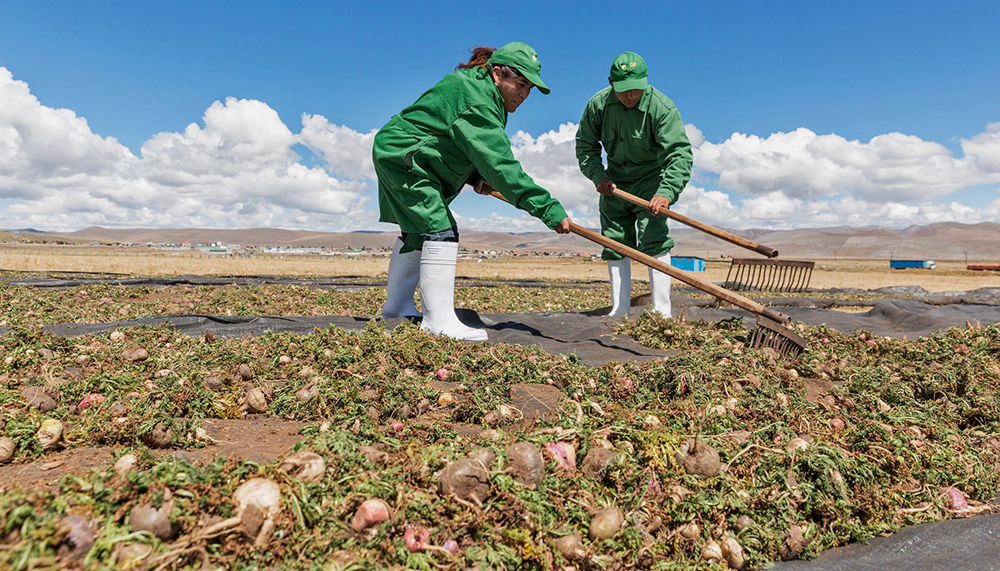
Maca roots drying in the sun using traditional Andean preservation methods before later cooking or other preparation.
Fermentation in Tents: Not Traditional
Claims that maca was traditionally fermented or stored in tents are not supported by traditional Andean preparation practices.
Indigenous Andean communities did not rely on fermentation tents or controlled fermentation as part of normal post-harvest maca drying. More importantly, maca was typically cooked before consumption, which already helped make it easier to digest.
Modern fermented maca products may use controlled microbial processes after drying. Fermentation can alter flavor and some compounds, but it is not required to make maca digestible, because traditional cooking and modern gelatinization already achieve that goal.
Does Fermentation Improve Digestibility?
Possibly — but this is not unique.
Fermentation may help break down some components, including certain starches. However, this is similar in practical effect to what boiling or gelatinization already accomplishes.
That means fermented maca is best understood as a modern processing variation, not as the only or “most natural” way to make maca easier on digestion.
Flavor Comparison
Both traditionally prepared (cooked) maca and gelatinized maca share similar flavor characteristics:
- Malty
- Earthy
- Slightly sweet
The idea that one is flavorful and the other is not is inaccurate.
Heat, Nutrients, and Reality
Some useful reference points:
- Enzymes begin degrading around 45°C (113°F–120°F)
- Vitamin C degrades significantly around 70°C (158°F) and above
So whether nutrients are affected depends on:
- Temperature
- Duration
- Processing method
This applies to all forms of heat processing, not just gelatinization.
Which Should You Choose?
The best choice depends less on marketing language and more on your digestion, preferences, and the quality of the maca itself.
Choose Raw Maca If:
- You want maca in its least processed dried form
- You tolerate raw starch well
- You prefer a product closer to its original dried state
If you are exploring less processed options, you may also want to read more about raw maca and our broader maca guide.
Choose Gelatinized Maca If:
- You have a more sensitive stomach
- You want a form of maca that many people find easier to digest
- You prefer a smoother flavor in drinks or recipes
You can also learn more about gelatinized maca and compare different options including red maca and black maca.
Fermented Maca
- A modern processing option
- Not a traditional Andean method
- Not automatically superior to gelatinized maca
Bottom Line
Many simplified comparisons online create a false narrative.
What’s accurate:
- Gelatinization is a controlled, short heating process
- It does not remove starch, but improves digestibility
- It does not eliminate flavor
- Most nutrients remain largely intact
What’s misleading:
- Claims of “long boiling”
- Claims that starch is removed
- Claims that fermentation is traditional
- Claims that gelatinization destroys most nutrients
Final Perspective
Both raw and gelatinized maca have their place.
- Raw maca: closer to its original dried state
- Gelatinized maca: easier to digest for many people
The key is understanding the actual processes rather than relying on simplified marketing graphics.
Frequently Asked Questions
1. What is the difference between gelatinized and fermented maca?
Gelatinized maca is heated in a controlled process to make its starches easier to digest. Fermented maca undergoes a fermentation step intended to break down some components. Both are processed forms of maca, but they are made using different methods.
2. Is fermented maca traditional?
No. Traditional maca preparation involved harvesting, sun-drying, and then cooking or boiling the root before eating it. Fermenting maca in tents or controlled environments is a modern processing method, not a traditional Andean practice.
3. Is gelatinized maca traditional?
The modern gelatinization process is not traditional in its exact form, but the use of heat is consistent with traditional preparation. Historically, maca was typically cooked or boiled before consumption.
4. Does gelatinized maca remove starch?
No. Gelatinization does not remove starch. It changes the structure of the starch, making it easier to digest.
5. Is fermented maca easier to digest than gelatinized maca?
Not necessarily. Fermentation may help break down some components, but gelatinization and traditional cooking already improve digestibility. Fermented maca is not uniquely easier to digest.
6. Does gelatinized maca destroy nutrients?
Gelatinization can reduce some heat-sensitive components, such as vitamin C and enzymes. However, it does not destroy all nutrients, and many compounds remain stable during controlled heating.
7. Is raw maca the traditional way to consume maca?
No. Maca has traditionally been cooked before it was eaten. Historically, it was commonly boiled or prepared in other cooked forms rather than consumed raw.
8. Is fermented maca better than gelatinized maca?
No single processing method is inherently superior. In practice, they perform similarly, and the better choice depends more on how the maca was grown, the quality of processing, and how it is stored.
About the Author
Mark Ament is the founder of The Maca Team. Through long-term work focused on Peruvian maca, direct relationships with growers and processors, and field visits in Peru, The Maca Team has spent years studying how maca is grown, dried, processed, and prepared in real-world conditions.
Recent Maca Posts
-
Gelatinized vs Fermented Maca: What’s the Real Difference?
Last updated: March 2026 This article is based on field observations in Peru, supplier documentatio …20th Mar 2026 -

7 Science-Backed Benefits of Maca Root
Maca root has gained global attention as a widely used superfood, but its use goes back thousands of …13th Mar 2026 -

Adaptogens Explained: Why Maca Root Deserves a Spot in Your Daily Routine
From demanding work schedules to family responsibilities and nonstop digital stimulation, many peopl …23rd Feb 2026